

Rings
by Nathan Grooms | 2026 Assistant Crew Leader
The tree is a monster. A ponderosa over three feet in diameter, charred at the roots, tangled in a forest of limbs, surrounded by shingles of bark littered in the trail. In the hot morning air, my saw partner and I stop, squinting in the bright sun as we size up the massive project. The limbs will need to be removed, and the sheer diameter will likely mean we must make multiple cuts, bucking the tree into movable pieces. The heavy root section of the tree is suspended in the air above the trail, held up by the sheer weight of its crown, which rests down the slope below the trail. The weight of the tree should pull our cut open as we make it, allowing us to easily saw through the massive ponderosa. Huge and easy to cut: what sawyers like to call a glory tree. In a few well-practiced movements the crosscut saw is taken out of its plastic sheathe, and the well-polished handles are attached at both ends. Crosscut saws like the bucking saw we are using were stamped in steel mills in the early 1900s. They stopped being produced when the advent of the chainsaw meant they were obsolete, but in the 1960s when the wilderness act was signed, crosscuts like ours found themselves in high demand once again. This particular saw is older than my grandparents. Using such a tool, it is difficult not to feel as though one is a part of something larger than oneself, especially in a place as ancient as these mountains. These thoughts flit through my mind as my saw partner unsheathes the ax and begins to remove the limbs one by one. Wordlessly I begin to swamp, tossing the massive limbs, twisted by time, down the slope. The morning air fills with the sound of the ax head biting the wood and the crunch of limbs landing in a pile. Soon our work area is clear, and the saw is moved into position. The handles are well worn, polished by many hands, crisscrossed with scrapes and scratches. “On my pull” I say into the silent morning air. The teeth of the saw bite eagerly into the wood of the ancient tree, rasping as they settle into their own path. As the teeth settle into their cut, my partner and I settle into our rhythm, back and forth, the saw swishing with a metallic resonance which all sawyers must appreciate. Simply put, it is beautiful. As the saw begins its song, my mind wanders, as it often does on hot clear mountain mornings when it seems most natural to cut in silence. Each stroke of the saw severs rings in the massive tree, turning them into nothing more than shavings. Each return stroke pulls these shavings out into the air and deposits them at my feet - all that remains of the rings of this ponderosa. Each ring is a manifestation of a year in the life of the behemoth, and each year tells its own story. The saw seems to whisper these stories as its teeth bite the soft pine. A bird calls distant and clear in the morning air.
Shhhk shhhk shhk . . . before the teeth have disappeared into the wood they have severed every ring of my young life. My time backpacking and canoeing. My dreams of becoming a homicide detective before I realized that the wilderness had a hold on me which could not be slipped so easily. All these reduced to sawdust fluffing in the air, drifting aimlessly.
Shhhk shhhk shhhk . . . now the saw’s rakers claw deeper into the fiber, severing the rings the tree laid down in the year 1991. The giant towered strong above the hillside, a tree among trees, while half a world away, my father was stationed on a missile cruiser in the Persian Gulf, watching Iraqi jets fly low over the horizon and wondering when he might see my mother again in San Diego. Perhaps my life was a dim thought in both of their minds, but nothing more,
Shhhk Shhhk Shhhk . . . Now the saw rips deep into the rings of the 1980s. Fat, healthy rings - these were good years for this tree. An osprey made its nest among the branches, as wildfires raged across the west. Yellowstone and its surrounding forests burned while millions of Americans watched the fires on color TVs. The forests near this mountain burned too, thousands of trees igniting in a rolling wave, but not this tree. And while the smoke drifted from valley to valley those hot dry summers, many sat in uneasy silence wondering if nuclear fire might not soon burn all the forests of the earth to ashes. Now the saw teeth slice cleanly through the ring this tree laid in 1985, the year my father graduated from high school, and prepared to leave his family farm for college, the first in his family to do so, but not the last.
Shhhk shhhk shhhk . . . the teeth of the saw work their way inexorably downward, further back in time. Soon they have sliced through all the years of my parents lives, for human lives are short to a tree as mighty as this. The years my grandfather taught geology and science at a highschool, the years before, when he met my grandmother as the two of them attended church together, all so brief that it takes only a few pulls of the saw to rip them all away. Every living person I have ever met, and all their collected years stacked together barely clear the top of the saw. There is nothing like a big tree to make one realize how small one's life really is.
Shhhk shhhk shhhk . . . The teeth of the saw bite into the rings of the 1950s, when many of the trees on nearby slopes were logged. Crashes of heavy timber falling all around, as mighty giants took their first steps on the path to becoming processed lumber. There was, after all, no such thing as a national wilderness. America had just emerged from a global war, and now it turned its attention inward, as houses sprang up from the ground like grasses after a spring rain. All the timber on earth seemed not enough to satisfy the growing giant's economy. Soon enough the teeth of the saw are severing rings made in 1944, when the steel mill which stamped the saw in my hands was converted to war production. Stamping no more crosscut saws, its hot cavernous floor instead churned out aircraft after aircraft, its former purpose forgotten in the excitement of conflict.
Shhhk shhhk shhhk . . . Now we saw through the rings of the 1930s, hard years for this tree, and hard years for many others. These rings are thin and flat, the summers were dry and long, with hardly enough rain to put energy into growth. The needles on its long branches were powdered with dust, kicked up by massive storms which raged across the west, darkening the sky with wind-blown topsoil, carrying away the hopes and dreams of so many. As the tree packed what little sugar it could spare away into its roots for the winter, families across the country packed away everything they owned and left their drought-stricken acres behind, desperately hoping to find something better down the road or across the mountains, or anywhere really.
Shhhk shhhk shhhk . . . Unseen by my partner or I, our saw slices through a thin black ring in a single pull. The year was 1910, when a young forest service faced its first real test, in the form of a fire as large as the state of Connecticut. Squirrels sheltered in the protective branches of the ponderosa, while a few valleys away a group of terrified young firefighters sheltered in a tiny mineshaft, as gas and smoke filled their entire world, hoping they would at least survive the night. “I need a rest” my partner says, wiping sweat from his forehead. We center the saw and wander to our respective packs. A few gulps of water, a handful of peanut M&Ms, and we are back at our handles. “I'll pull”, my partner says. The song of the saw starts again.
Shhhk shhhk shhhk . . . One of the countless pulls of the saw, indistinguishable from any of the other countless pulls, severs the ring the tree put on the year 1899 became 1900, a whole century looks unimpressive when it represents less than a quarter of this tree's diameter. Now we saw through the 1890s, when Butte became the center of a copper boom which would make many rich and ruin others. We slice the ring laid in 1890, when the land all around us was given the label of statehood, and the name Idaho. Fat and buttery rings marked out the 1880s - our tree was growing rapidly then, and our saw is now pulling out long curls of wood, forming a pile near my boots.
Shhhk shhhk shhhk . . . The morning is growing hot, and the air smells of that warm and buttery pine scent which is so difficult to put into words. We pull our way through the 1870s. The tree stood large among forests of untouched and untouchable pines and firs. Further south, warriors of the Nez Perce tribe held off the U.S army long enough for women and children to escape the long, clutching talons of manifest destiny, before fleeing themselves. Our saw turns into curling wood the ring laid in 1876, when a young man named Crazy Horse painted red lightning on his face, mounting his horse to lead his people to victory against the U.S. 7th Cavalry. The saw rasps through rings marking years of heartbreak and loss, as pieces of paper with government seals reduced the land free peoples had inhabited for millennia to tiny reservations, and then made those reservations smaller still. We slice through wood which was young and green and new when the U.S government offered free land to anyone who would venture into the unsettled west to claim it, and deeper still through rings laid before any white man had planted a surveying rod on the side of this valley at all, rings laid as in the east, American armies burned American cities to the ground, leaving scars on the land which would never heal.
Shhhk shhhk shhhk . . . The blade of our saw is hot to the touch as we pull it through wood the tree laid the same year a lump of gold discovered in a California stream started a mass migration, when the only settlements within a thousand miles of the base of our tree were trading posts and tiny trapping cabins. As the saw sinks deeper the rings grow wider, our tree was young and growing, competing with many neighbors for sunlight, and enduring hard winters with feet of deep silent snow. We sever a ring made the same winter the trees branches bowed under the weight of fresh powder, as nearby a starving Corps of Discovery slaughtered their horses for food, desperately lost on their journey to the Pacific. And the birds and the wolves and the wildflowers took no notice as the land they lived on and everything else as far as the highest soaring bird could see changed hands with the stroke of a pen, becoming the Louisiana territory. “Water break?” I ask, and soon my partner and I are sitting in the shade of a fir, sipping water filtered from a nearby creek. A handful of trail mix, an offhanded remark about how far ahead the rest of the crew will be before we finish cutting, and we are back to our positions. “My pull” my partner says. The saw is in motion again.
Shhhk shhhk shhhk . . . The saw teeth are nearing the center of the vast tree now, the rings smaller and smaller, marking the youthful years of this tree's life. Our pulls have gotten shorter now, as the tree's full thickness nearly swallows the blade. We slice through a ring laid the year 39 delegates from 12 young states placed their signatures on the United States constitution. A ring laid in the same year colonial armies forced the British empire to surrender at Yorktown. Our saw bites through a ring laid when the tree was only a little taller than I am, the same year under another tree in Massachusetts, a young George Washington assumed command of the newly formed Continental Army, in open defiance of the most powerful empire on earth. And as a group of small business owners and farmers met in secret in a tavern to discuss their discontent with the King and his taxes, a tiny sapling emerged from a cone on the side of a mountain which had no name. It would grow for 262 years, before falling, only to be cut by a 24 year old from Wisconsin.
The saw thrums with that peculiar metallic song, now through the core of the tree, sawing its way back through all the years of the ponderosa's long life. My mind tries to imagine all the stacked lives which could fit within this one trunk. It is more than I can wrap my head around. More than anyone can wrap their head around. These are two wildly different scales of time. And as the tree finally begins to pop and groan, we pull the saw which is older than any person I have ever met from within the tree which is older than my country. A few more short pulls, a crack and a crash, and the cut is complete. The tree lies in pieces in the trail, we will need more than just the two of us to move it. My partner replaces the sheathe onto the antique saw, we shrug into our packs. I stare for a moment at the rings, nested one within another, occasionally interrupted by some scar or a limb the giant swallowed as it grew. A bird calls distant and clear in the morning air. “I'm hungry”, my saw partner says loudly. “Lets see if we can catch the rest of the crew and take lunch”.
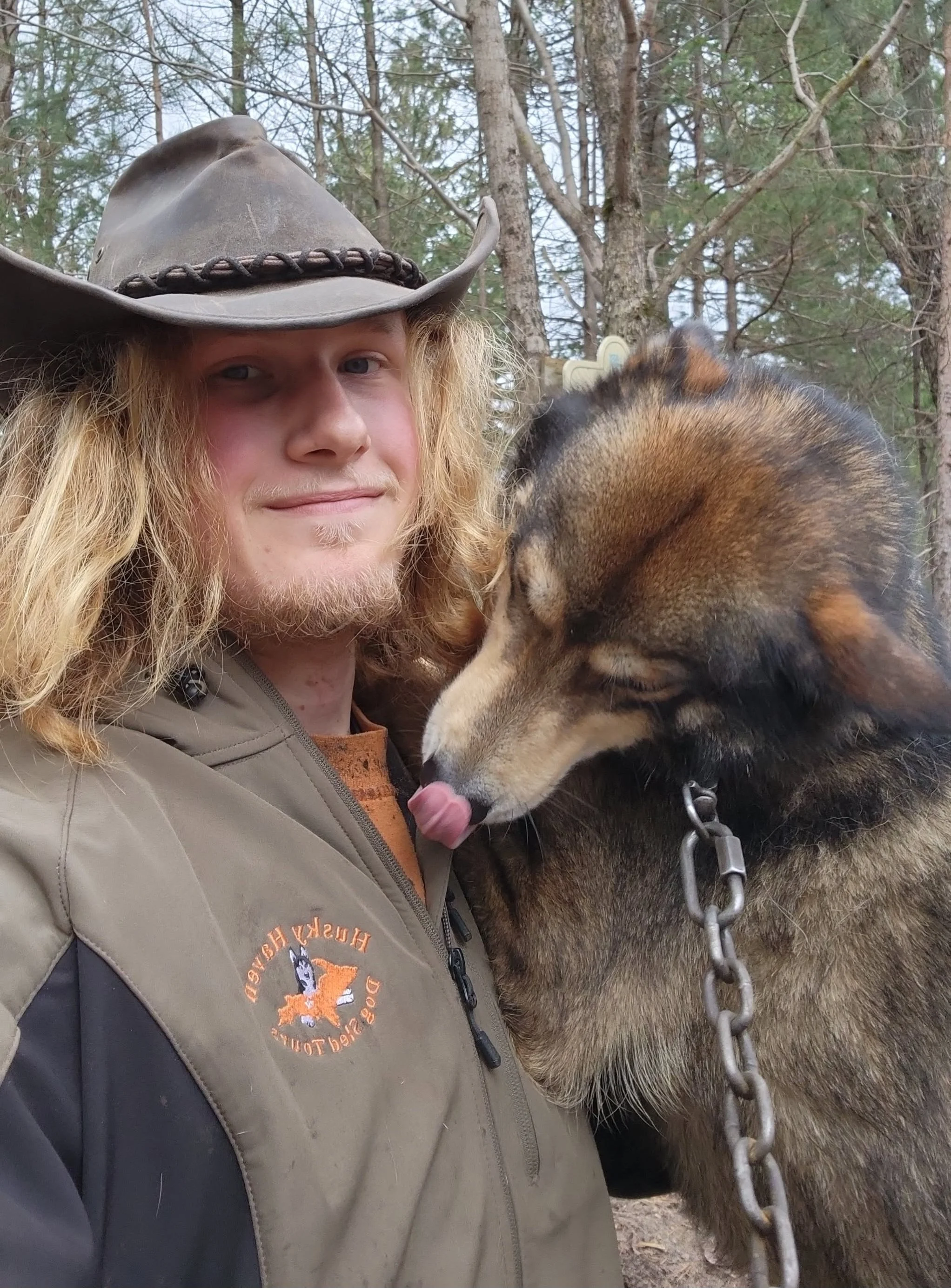
Nathan Grooms, Assistant Crew Leader
Nathan grew up in the driftless region of wisconsin, hiking and camping. He discovered a love of wilderness in the Boundary Waters, where he worked as a guide. He spends his summers working outdoors, and mushes Alaskan huskies during the winter seasons.