Be Like a Plant

Karlissa Skinner

Wilderness Project Liaison

Hitch 4 – CatRock Ventures Volunteer Project, July 18-25

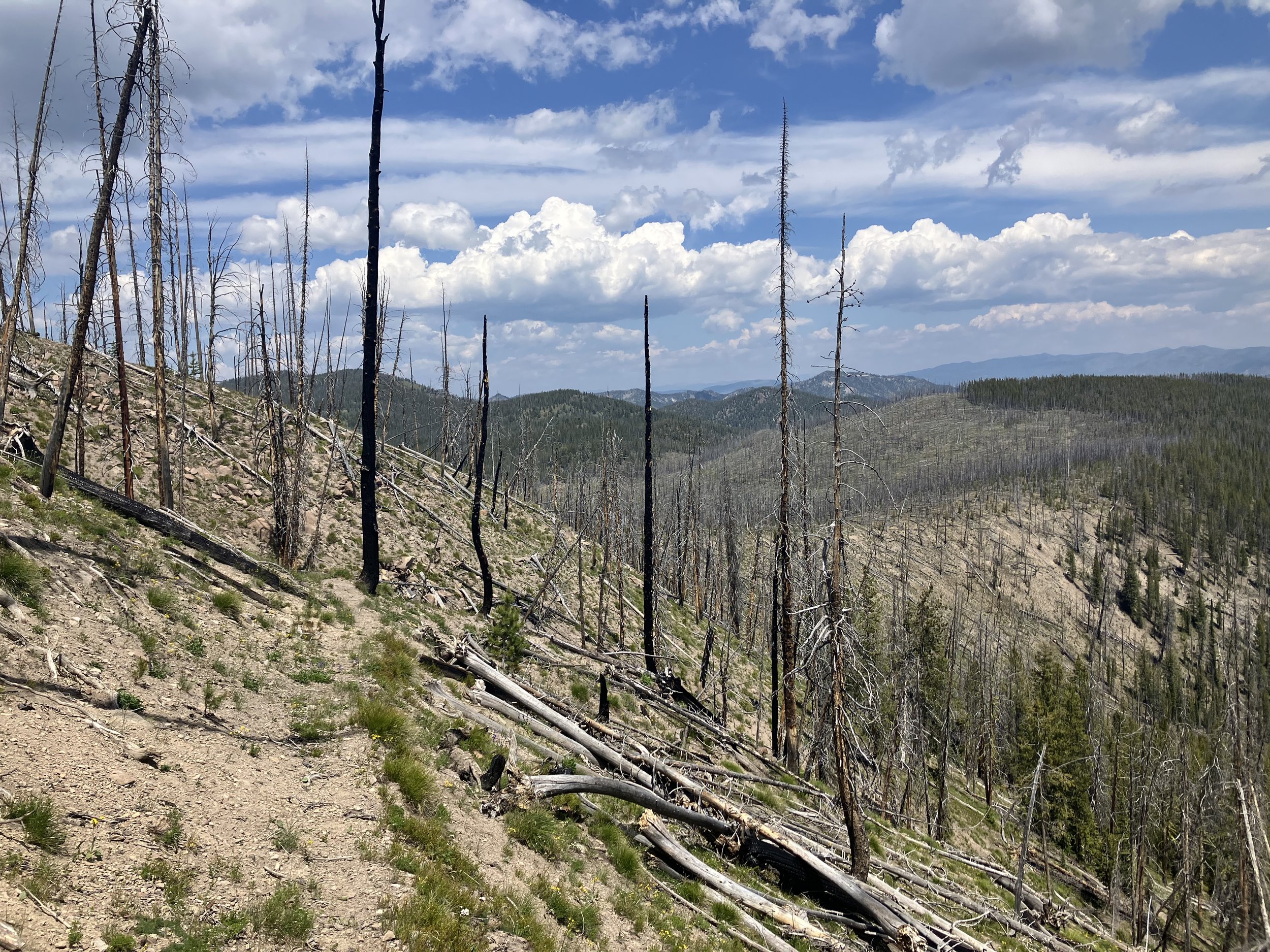
Lolo Peak Trail and One Horse Lakes Trail | Bitterroot National Forest | Selway-Bitterroot Wilderness

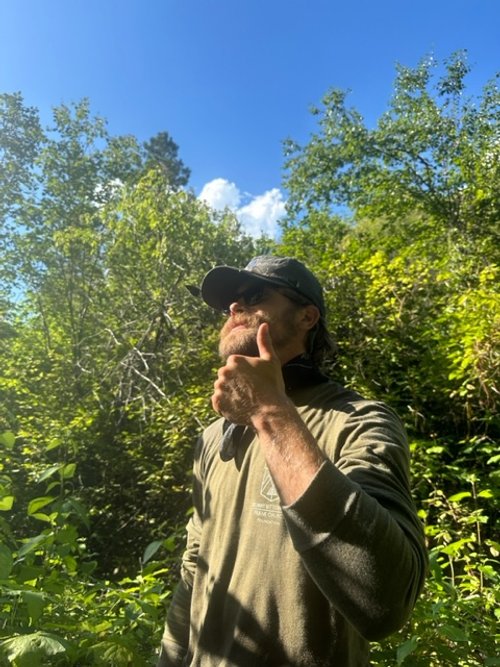
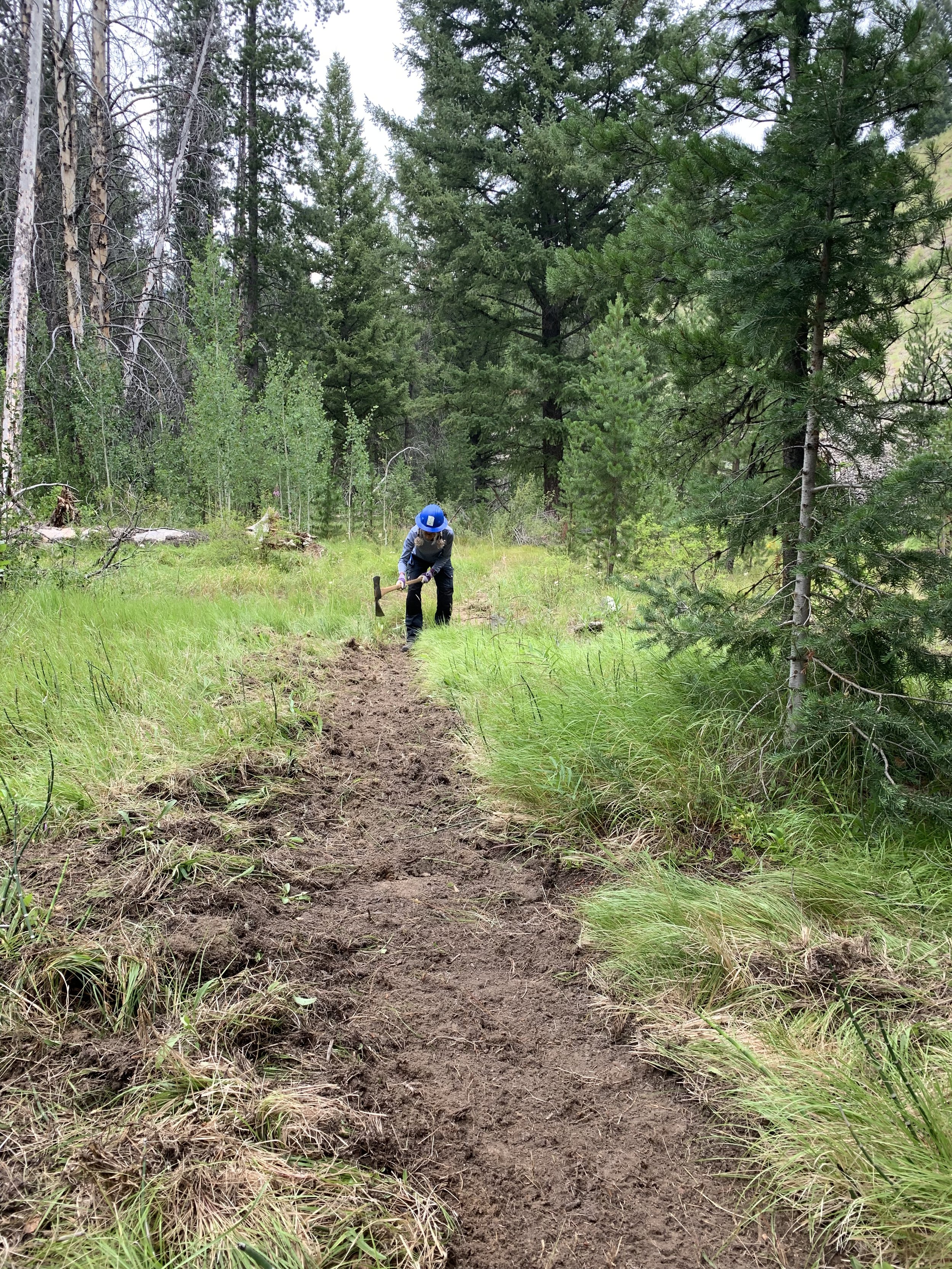
It’s hard to believe summer (and the trail work season) is nearly over… I savor these dog days on the trails, when I smell the Ponderosas and huckleberries before I even see them. This being my fifth field season, I have come to recognize, anticipate and truly appreciate the seasonal succession of plant life in the Wilderness areas I get to call my office. Plants have offered me endless inspiration, peace and wisdom over the years, and this season the lesson that pervades is resilience. I have greeted all the familiar wildflowers and even gotten to know a few new ones, but what I’ve noticed with the most poignancy is the plants that seem to defy the odds and grow in unexpected places—specifically right in the middle of a rock.

These tenacious plants stop me in my tracks and pull me out of my head and back to the present moment. I wonder, “how the heck…?” And then I realize: if these plants can grow in/on/through solid stone, then I can handle x, y, z, fill in the blanks with whatever I was worrying about before I stopped to admire such an impressive phenomenon.

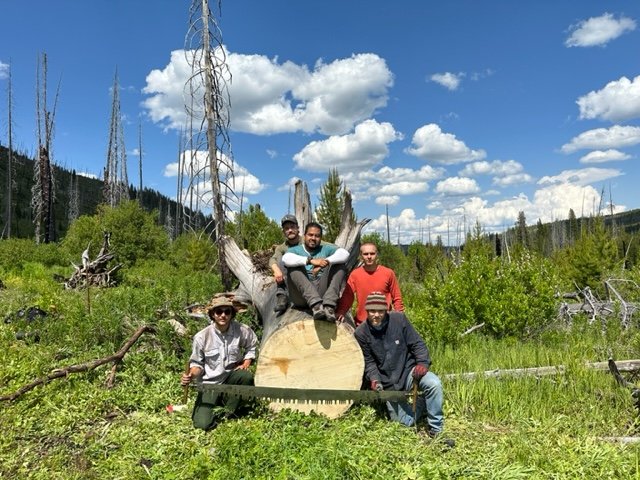
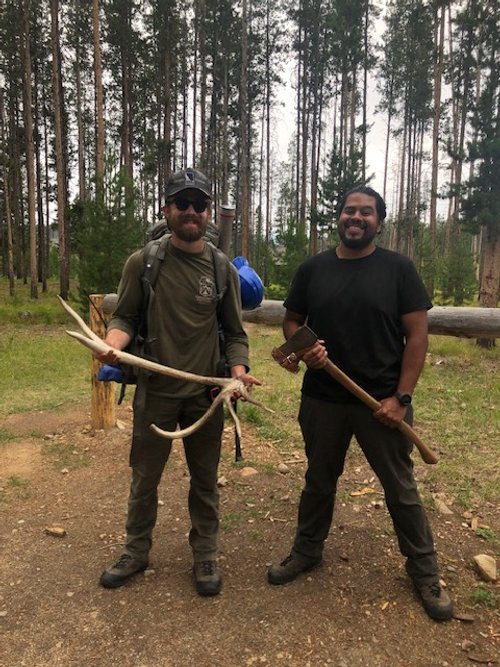
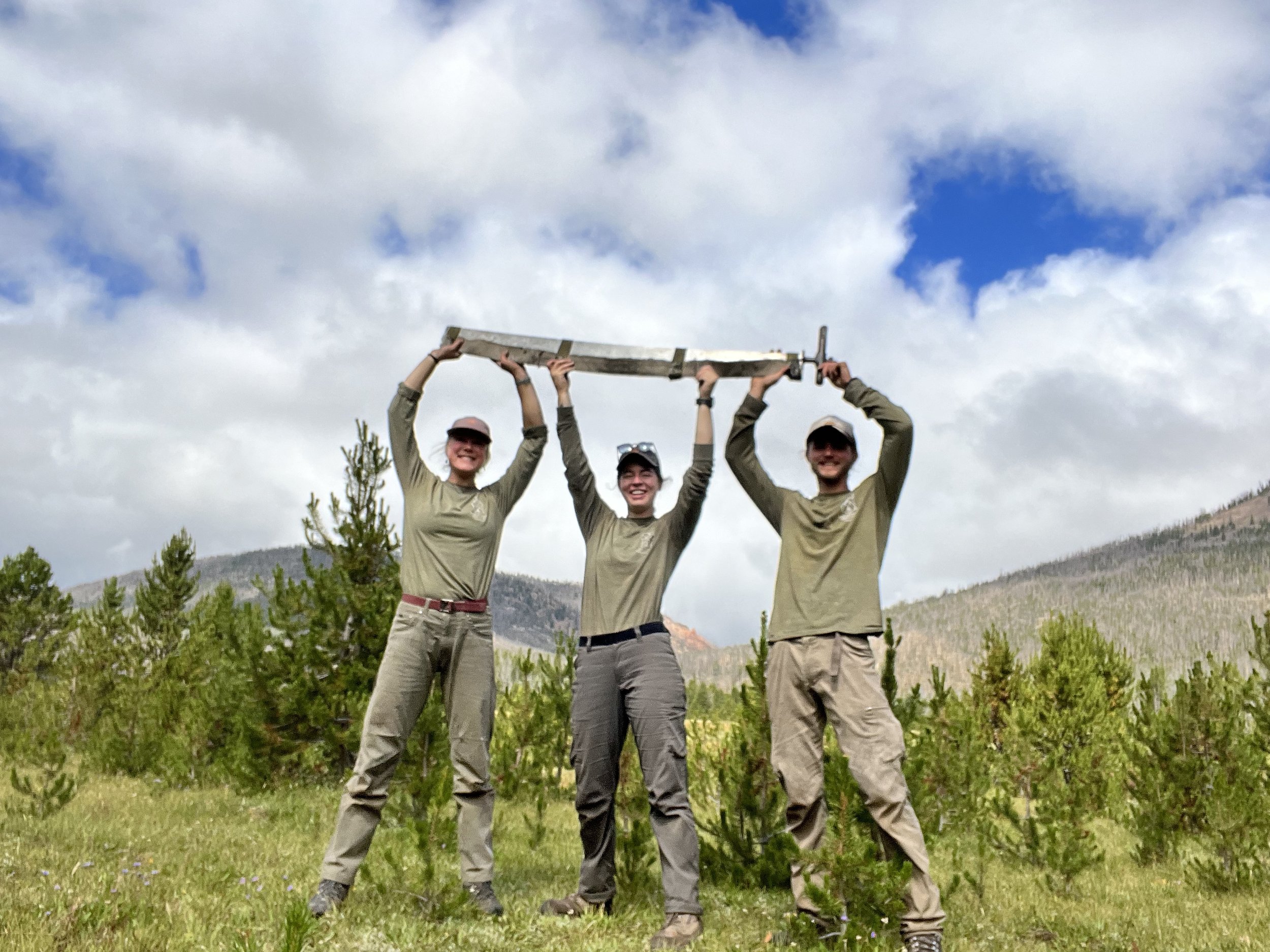
And the beauty of my position leading different volunteer projects all summer is getting to witness other people have these realizations as well. I recently had the opportunity to work with volunteers from CatRock Ventures, an inspiring nonprofit based in New York whose mission is to invest in the success of Bronx youth by providing experiences in leadership, outdoor recreation and environmental stewardship. Daphne, Jeton and Jordan, accompanied by group heroes (oops, I meant leaders) Abiola and Cam, flew into Missoula the weekend before the project and got to explore Missoula and Glacier National Park before venturing into the Wilderness to put their leadership and stewardship training into practice! However, NYC training couldn’t fully prepare them for some of the challenges (and rewards!) ahead. In those first few days I heard a lot of awe-inspired exclamations: “it’s so quiet,” “the air smells so good,” “there are so many plants.” I watched them experience pure bliss as they got to ride a horse, roast a marshmallow (and then another, and another, and another…), splash in an alpine lake, and dance around a campfire. This perspective is such a joyful reminder to not take for granted how lucky I am to have grown up in Montana.

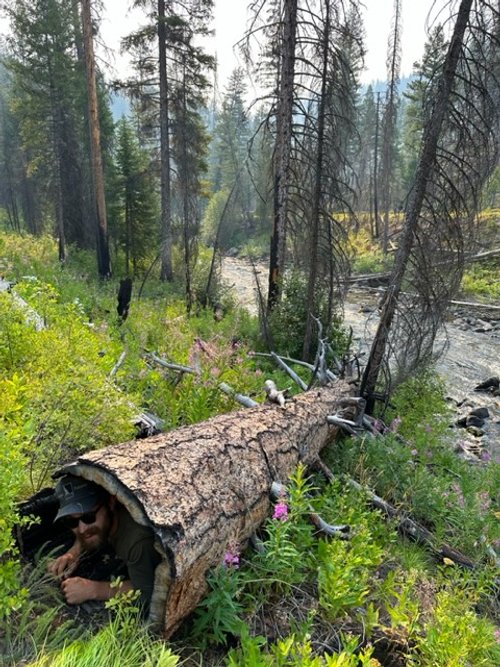
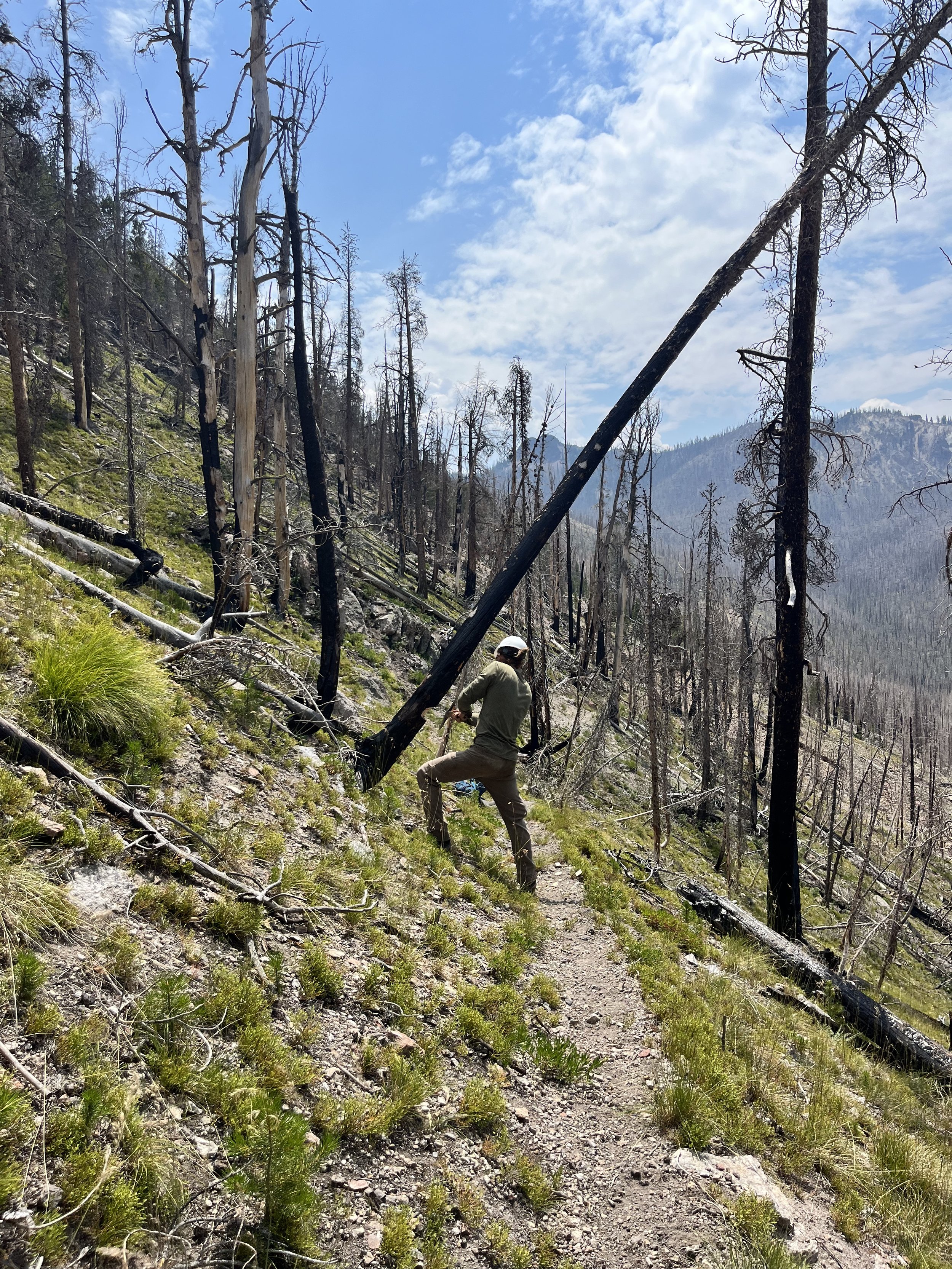
On the other hand, though, the steep hikes, long days analyzing cut plans and pulling a crosscut, and ruthless mosquitoes are all just another part of the experience for me. But for Daphne, Jeton, and Jordan, these less glamorous aspects of trail work proved to be quite difficult at times. We scrambled a steep grade to Lolo Peak, conquered a technical 8-tree root ball, and learned to “embrace the suck” (a trail work philosophy that encourages us to do our best to enjoy our circumstances despite rain, mosquitoes, etc). In just a week I noticed so much progress in their ability to communicate and clear trail, offer help with camp chores, and endure the relentless mosquitoes to enjoy campfire chats and s’mores. I think it’s safe to say that it was a life-changing week for them. I’m so inspired by their plant-like tenacity and so humbled by Cam and Abiola’s commitment to CatRock’s mission.

Before- 8 tree root ball!

After- 8 tree root ball!

This is my fifth summer having spent more nights in the backcountry than in the city.

I’m frequently struck with an overwhelming sense of wonder and gratitude for all the trail miles, stunning peak views, alpine lake sunrises, river lullabies and plant wisdom. And it’s so special to share these Wilderness appreciation moments with so many eager volunteers throughout the summer. We get to learn together that the greatest challenges yield the greatest rewards, and persistence builds resilience. We’re not only enduring, but thriving in challenging environments, adapting to changing conditions, growing stronger for the obstacles we overcome.


KARLISSA SKINNER

Wilderness Project Liaison

Selway-Bitterroot & Frank Church-RONR Wilderness

Karlissa spent her summers hiking and camping around Helena, Montana. Her conservation corps experience doing trail work and living in the Frank Church-River of No Return Wilderness helped her to discover her love for the natural world and wilderness conservation. Karlissa is an avid rock climber, backpacker, and river rafter.

A Subtle Reminder

Enzo Santarone

Wilderness Ranger Fellow

Payette National Forest | Frank Church-River of No Return Wilderness

Editor’s Note: Enzo was immersed at the Chamberlain Guard Station all summer (June-August). He handwrote / mailed his blog post to the SBFC offices.

A Subtle Reminder:

To the wolf on the far ridge 

I’m glad to have heard your call 

I was lost in the trance a campfire puts you in

When you stare too long 

Waiting for the rain to cease

And too busy thinking about when I would be able to dry my socks 

Tending to the blisters left by my ax’s handle 

Your call was a reminder of where I truly was


Author’s Note:

Because I simply do not say it enough, thank you to all of those who have contributed to or aided me in my journey leading me to where I am as I write this letter. To my parents, thank you for instilling in me a curiosity to seek out the adventures in life. To my loving and supportive partner, thank you for the letters, dehydrated camp meals, and snacks. My life would be a dull and hunger-filled one without you. To all SBFC staff and Wilderness Rangers Fellows, thank you for sharing your perspectives, stories, and camp food recipes; the memories made in Missoula will be cherished. To USFS Rangers Ben Cartwright and Kaylee Fritchen, I can’t thank you enough for your service and support to the vast wilderness surrounding us. 

A photo/video review of Enzo’s summer:


ENZO SANTARONE

Payette National Forest | Frank Church-RONR Wilderness

Boise State University

Major: Environmental Studies

Enzo was born in Boise, Idaho, and was raised immersed in the outdoors with experiences like sailing, hunting, and fishing with friends and family. Through his experiences in the outdoors, Enzo has fostered a connection with and love for nature. He hopes to contribute to the work that allows others to find this same connection.

Interview: Marble Creek

Marble Creek trail sign

Tom Klein has been an SBFC volunteer for many years. He’s an avid hiker and trail runner and professor at Idaho State University in Pocatello. He has seen the trail in Marble Creek come back to life since 2016 when he first visited. We asked him to share some of his experiences and his advice for people who are curious about exploring this very wild part of the Frank.

SBFC: How many trips have you taken on the Marble Creek Trail?

Tom K: I have been back to Marble Creek 5 times now, which is hard to believe, given how remote it is.

SBFC: What year did you first visit Marble Creek? 

Tom K: I first visited it in 2016, when I was working hard to complete the Idaho Centennial Trail--or at least do a big chunk of it. That year, I hiked up Marble Creek and met an SBFC crew which was working its way down. I've since joined a number of SBFC projects working up from the bottom and top.

SBFC: What is so special about this trail and this part of the Frank to you? 

Tom K:  The trail is well known as being challenging, and that appealed to me. It really is deep in the Frank Church, so if you want to have a true backcountry experience, that is the place to go. In addition, it has an interesting history, with the Mitchell Ranch at the bottom and the Belco Mine near the top. There are some interesting cliffs about 10-15 miles up that have the original old fence Billy Mitchell put in to close the top end of his ranch. In addition, near the upper end, there are many old remnants of the old mine.

SBFC: Should people consider a hike on Marble Creek, and if so why?

Tom K: I would encourage experienced hikers to give the trail a try. It's remote and dramatic and also is a good test for advanced hikers. In addition, you get to see the Middle Fork of the Salmon as well as the interesting and rugged area east of Yellow Pine.


SBFC: What advice do you have for people who would like to experience Marble Creek? 

Tom K: Because of the many, many river crossings, I would advise people to be prepared for wet feet. I would also suggest waiting until later in the season when the stream flows are lower. One hiker got injured right at the bottom due to high flows in June. I would recommend poles for the crossing, as well as a steady head for one or two high slopes that can be subject to slides. Be prepared for delays and keep a calm head. Also, note that some of the stream crossings can be diagonal upstream. For people on horseback, I would suggest using calm, highly experienced animals that can deal with the terrain.
SBFC: Talk a little bit about the changes you've seen on this trail from your first trip here until today. 

2023 Marble Creek Volunteers

Tom K: The trail has gotten a lot of love lately. I would be surprised if people lost the trail now, which happened to me. The heavy growth, especially by stream banks, has been cut back, and many fallen trees have been removed (though more can always fall). The trail tread is much better established.

When I first went through, there were heavy thickets that ended up in deep pools. I was wet and had torn clothes when I finished, but it's much more passable now. It's still pretty lightly used, and the majority of the people that go up there are the crews themselves. Hopefully, that will begin to change, though this area will always be remote. You either have to get in from the Middle Fork, which can take a couple of days unless you fly into the Thomas Creek airstrip, or from Yellow Pine, which is a good two-hour drive past the fairly active Stibnite mine site.

Thank you, Tom, for taking the time to share with our SBFC readers!

"With one terminus at the Middle Fork of the Salmon River, the other at a mountain top, and dozens of creek crossings in between, the Marble Creek trail is an excellent example of the ruggedness, storied history, and wild beauty that the Frank Church-River of No Return Wilderness holds. The trail will never be a "walk in the park,” nor would I ever want it to be, but thanks to the great efforts of volunteers like Tom, adventurous souls can experience this vein of the Frank Church in an appropriately wild, but manageable manner."

-Josh Page, SBFC Program Director


SBFC worked two hitches on Marble Creek in 2023. This work was funded by private donations and through grants from Idaho Parks and Rec and the Southwest Idaho Resource Advisory Committee.

Going the Distance

Ryan Murphy

Wilderness Ranger Fellow

Hitch 5: Elk Summit | August 3-8, 2023

Nez Perce-Clearwater National Forests

The burn area within the old growth cedar forest. The photo does not do the size of these trees justice. Photo by: Ryan Murphy

Many miles and many cuts later the season has come to a close. It feels like just yesterday that I put my pack on and picked up some tools for the first time. My name is Ryan Murphy and I am from New Jersey, which is quite the opposite of a wilderness area in Montana/Idaho. I graduated from the University of Utah with a degree in Parks, Recreation, and Tourism in May and drove straight to Missoula only days later. Four hitches later and I am standing at the trailhead ready to embark on “the hitch” of all hitches, as my crew leader Connor had referred to it all season. In fact, I think it was one of the first things he said to us when we met him: “I have laid out the hitches so that we are in good enough shape to be able to attempt the last one.” 
The author approaching Maple Lake to make camp on our fourth day. Photo by: Connor Adams

Because of the nature of the forest I worked in, we did lots of campsite monitoring all summer. Campsite monitoring refers to filling out forms to accurately track the degradation or naturalization of an area where people camp. This is an appreciated break from the monotony of trail work, however, this does mean that my crew had to cover lots of miles on trails that we did not have the time to clear. 

For example, on day two of hitch five, we hiked 24 miles with our day packs to monitor two campsites. Believe it or not, this was one of the less taxing days of hitch five. Besides the expected chafing everything else went very smoothly. It didn’t rain on us, the trail was relatively clear, and the trail followed a creek that runs through an old-growth cedar forest, so it was absolutely beautiful. Unfortunately part of it had burned in 2018, but it is still my favorite place in the forest so far. 

Some old trail dogs showing us how it is done. Connor Adams and a celebrity appearance from our very own Josh Page (SBFC Program Director). Photo by Ryan Murphy

The hardest day of hitch five was on day five. My crew member Olivia and I hiked 16 miles on a so-called “trail” to monitor some campsites. This trail must've been cleared 10 years ago and not since. We climbed over, under, and around 2,014 trees. Thirteen hours and 16 miles later we returned to camp to see Connor kicked back in a chair reading a book. Turns out he knew how rough that day was going to be and sent us not because he was being lazy but because he wanted to show us what we were capable of. All season he would say that you are 10 times more capable than you think you are and this was his final way of showing it. 

Overall this season has taught me to be confident in myself and to lean into the hard work rather than shying away from it because nothing will force you to look inward more than climbing over downed trees all day in the rain.


RYAN MURPHY

Nez Perce-Clearwater National Forest | Selway-Bitterroot Wilderness

University of Utah

Major: Parks, Recreation, and Tourism

Ryan grew up in Fairfield, New Jersey far from the outdoors. He had little work experience before joining SBFC but has always been passionate about the environment. Growing up he would take annual ski trips to Colorado and summer trips to Wyoming. This sparked his interest in all things outdoors and eventually landed him at the University of Utah. With his Parks, Recreation, and Tourism major he hopes to continue exploring the country and serving the environment in every way he can.

One Final Adventure

Jersey Hoover

Wilderness Fellow Ranger

East Fork Mayfield Trail

Salmon-Challis National Forest | Frank Church-River of No Return Wilderness

Alex axing the pie out of a tree

Coming off a previous hitch of strenuous terrain and seldom work, I was eager for a change of pace. Mayfield offered just that. If I could mold a hitch into perfection, it would consist of everything Mayfield offered. The work-to-hike ratio was ideal, the terrain was mild compared to what we were used to, and I felt I was serving a purpose. Perhaps I would change some things for safety, such as the weather. However, I am not the one to control that. Plus, it adds to the adventure and the story.

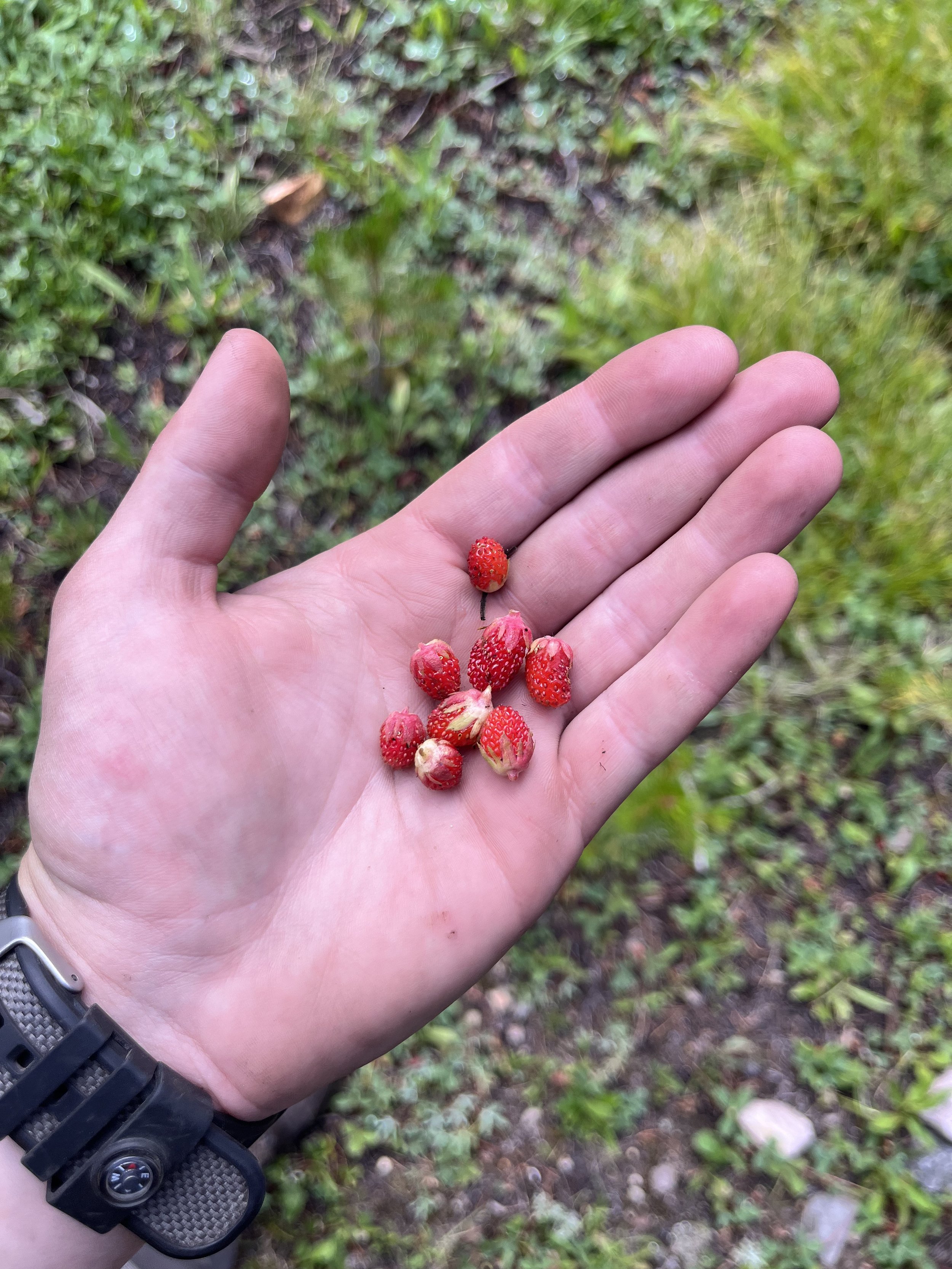
Strawberries along the East Fork Mayfield Trail

We began our hitch with an easy 5-mile hike on a dirt bike trail, just outside the wilderness, on FLAT terrain; yes, I said flat. A concept unknown to us after our season in the Frank Church-River of No Return Wilderness. Little strawberries lined the trail, keeping us refreshed as we moved forward. We set up our camp outside the burn area we would be working in for the next seven days. Each day consisted of a 4-mile hike into the wilderness where we began to see some elevation change. Nothing we could not handle at this point in the season. This portion of the trail had not seen maintenance in many years, so we had our work cut out for us (no pun intended).

Heather walking along the Mayfield trail, just pass the wilderness border

The following days proved themselves to be eventful. As I was cutting a tree, I heard some aggressive noises coming from the other side of the ridge, high winds followed by multiple trees falling. When I turned to see what was happening, I saw a small tornado making its way over and down the ridge, gaining speed and size as it moved downward toward us. Thankfully it dispersed before it got too close, but it was a thrilling sight. This would not be the last adrenaline pump of the hitch. The next day presented an intense hail and lightning storm that had us cold, soaked, and holding lightning position for roughly 45 minutes. Although the condition was not ideal, we kept light conversations of warm thoughts to keep our minds at ease. As strange as it sounds, it was enjoyable. It is the rough times that really bond us as a crew. When we were comfortable starting work again, we watched a tree fall 50 yards in front of us (the first of two trees I would watch fall this hitch). That was our sign to leave the area, so we quickly gathered the tools, sending a burning sting down Alex and my arms, as the lighting had electrically charged our tools.

That same day, back at camp we watched a large hawk prey upon a squirrel and fly away just feet in front of us! The following day a red fox trotted down the trail right through our camp!

Heather and Alex crosscutting a tree

This being Heather and my’s last hitch of the season brought many bittersweet emotions. At times we were ready to be done, and at others, the thought of leaving this work and each other was nothing but upsetting. As a crew, we conquered challenges we could not have imagined and experienced lifetime highs. It is a bonding one cannot put into words. The East Fork Mayfield Trail was the perfect hitch to end our season.  We cleared 342 trees and brought the beginning portion of the trail back to life. 

Final day celebration (Heather, Jersey, and Alex)

Another final day celebration


JERSEY HOOVER

Salmon-Challis National Forest | Frank Church-RONR Wilderness

Northern Michigan University

Major: Criminal Justice & Wildlife Conservation

Jersey is a senior at Northern Michigan University where she studies Criminal Justice and Wildlife Conservation. She plans to enter the DNR as a Conservation Officer proceeding graduation. Jersey grew up participating in outdoor activities and took a particular interest in bowhunting at a young age. She now spends most of her time in the backcountry on hunting or backpacking trips. Her great interest in wilderness conservation and desire to explore the western states led her to join the 2023 SBFC Wilderness Ranger Fellowship crew!

Stream (Creek) of Consciousness 

Ariel Centeno

Wilderness Ranger Fellow

Frank Church River of No Return Wilderness

Hitch 5- Marble Creek | August 2-9 

George Lucas once said that Star Wars is like poetry…it rhymes. I don’t fully know if that applies to trail work, but it’s a quote that kept rolling around in my head on Marble Creek. Being the last hitch of our season, I kept reflecting on our first hitch on the Chamberlain trail. On our first hitch, we hiked up a canyon, on our last, we hiked down a canyon. That’s like poetry, right?

Julian and the mules

Unlike Chamberlain, this time I felt far more mentally and physically prepared to take on Marble Creek. Maybe a little too prepared. Marble was different than the rest of our hitches for the best reasons. This time around, our 3 man crew of Dylan, Julian, and I were accompanied by an awesome group of volunteers and a cowboy poet and his pack of mules. This group was an eclectic mix of chefs, trail workers, sign makers, rafters, entrepreneurs, firefighters/professors, nutritionists, worm farmers, farmer market ninjas, and everything in between. The one thing we all had in common is that when it was time to work, we WORKED.

Most of Marble was already cleared of trees when we got down there, however, the trail was basically hidden by overgrown grasses, bushes, and rockslides. This time around, we traded our saws for Pulaskis. The first few work days we focused on brushing, lopping, and clearing those rockslides to make the first few miles of Marble a dream to hike through. Flower meadows, beaver dams, and plenty of creek crossings.

Breakfast, lunch and snacks packed in for Marble Creek

Actually, too many creek crossings. By the third workday, I think most of us gave up on switching out our boots for sandals. Marble Creek seems to be a little infamous for the number of creek crossings it has. Each crossing just happens to be spaced out so that as soon as your socks begin to dry, there’s another crossing. Wet feet, wet boots, cloudy days, and cold mornings.

Dylan cooking breakfast for the trail crew

Food. Lots of food. Thanks to volunteers, we traded instant rice and ramen for Spaghetti Carbonara, chili, mac and cheese that isn’t just noodles and cheese powder. And for dessert? Candy, so much candy. It's not a proper hitch without at least 3 Starbursts a day.

Switching back to the work, we actually ran into an SCA crew that was working from the opposite end of the trail. They let us know that they cleared their end of the trail with the exception of 3 trees. They told us they weren’t able to cut them due to the size and nature of them. So of course, we NEEDED to get to them. Those SCA guys weren’t kidding. Of all the trees Julian, Dylan, and I have cut, these were by far the most tricky ones. The first was a no-brainer but was one of the largest we’ve cut this season. Trees 2 and 3…. Yikes.

Tree number 2. The steep angle, loose rocks and hanging roots made this a challenging cut (Photo by Michelle Florence)

Managing to clear the second tree was one of the most rewarding experiences this summer.

Tree three, however, was basically impossible to clear with just our saws. I wouldn’t call it a defeat, more of a strategic retreat. Still, just one downed tree on the entire trail? That’s a win by my standards.

Okay, so maybe it wasn’t anything like Chamberlain other than it also being a canyon. Maybe less like a poem, and more like a victory lap. Good company, good food, good views, mules for ambiance, and one really awesome gift from John, one of the volunteers. Marble Creek really was a great way to end the season.

The Marble Creek team posing with our Frank Church signs made by volunteer John (Trailhead DesignWorks)

Eric, one of the volunteers, clearing an overgrown part of the trail (photo by Michelle)

Michelle, one of the volunteers, clearing an overgrown part of the trail


Payette National Forest | Frank Church-RONR Wilderness

Florida International University

Sustainability & the Environment

Ariel grew up in the suburbs of Miami, FL. He became interested in the outdoors after going camping for the first time in early high school. After that trip, he made an effort to go as often as possible, and now has an internship working in south Florida’s wetlands. He is excited to join SBFC and work in wilderness.


Gifts from the Land

Michael C. Sanchez

Wilderness Ranger Fellow

July 4-13 | Payette National Forest

Frank Church-River of No Return Wilderness

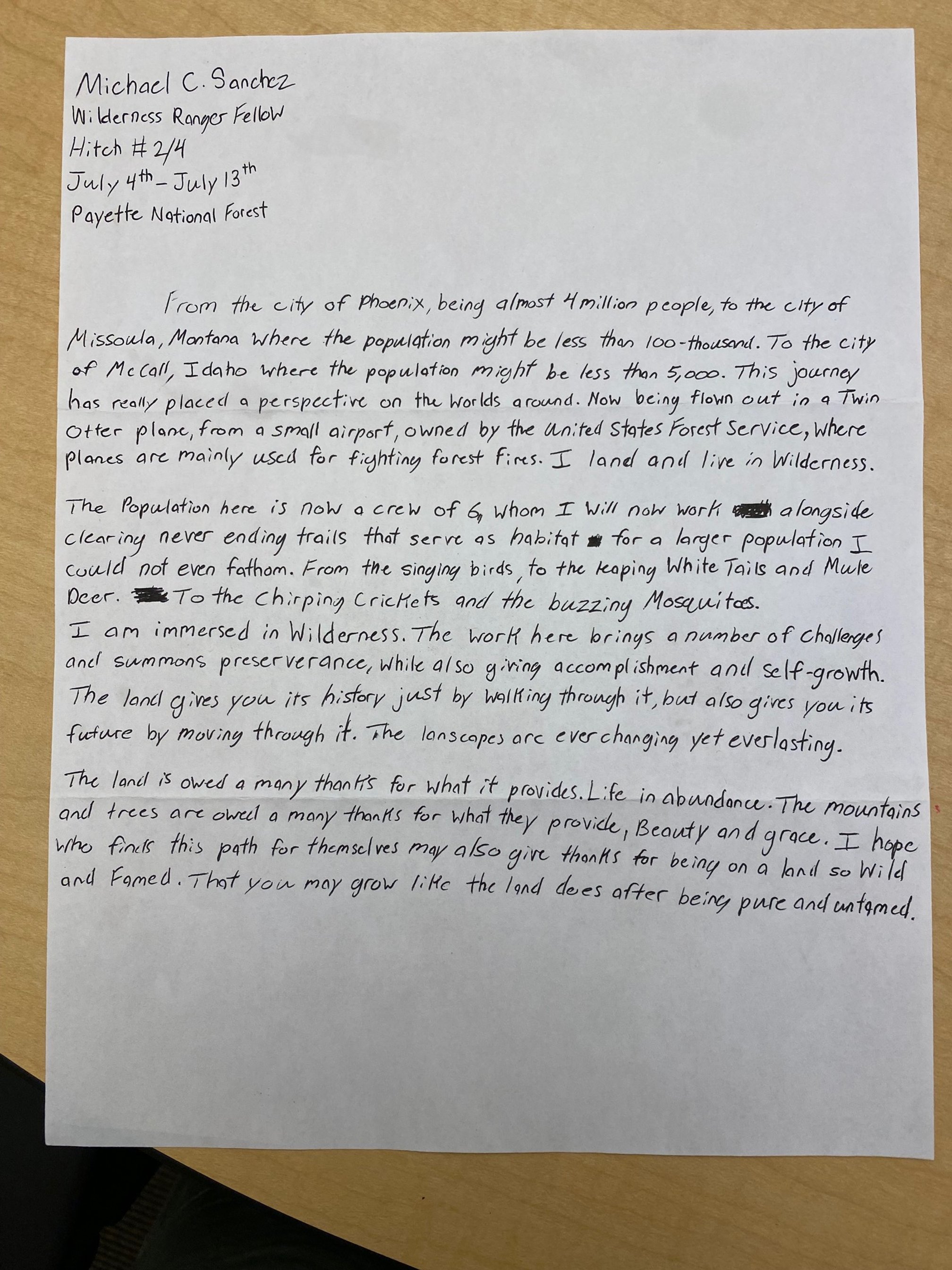
Editor’s Note: Michael was immersed in the Frank Church-RONR Wilderness this summer. He mailed his handwritten blog post to our offices in Boise!

From the city of Phoenix, being almost 2 million people, to the city of Missoula, Montana, where the population is less than 100,000. To the city of McCall, Idaho where the population might be less than 4,000. This journey has really placed a perspective on the world around me. 

Now being flown out into the Frank Church-River of No Return Wilderness in a Twin Otter plane, from a small airport, owned by the United States Forest Service, where planes are mainly used for fighting forest fires. I land and live in Wilderness.

The population here is now a crew of 6, whom I will work alongside, clearing never-ending trails that serve as habitat for a larger population I could not even fathom. From the singing birds to the leaping White Tails and Mule Deer; to the chirping crickets and the buzzing mosquitoes.

I am immersed in Wilderness. The work here brings a number of challenges and summons perseverance, while also giving accomplishment and self-growth.

The land gives you its history just by walking through it, but also gives you its future by moving through it. The landscapes are ever-changing yet everlasting.

The land is owed many thanks for what it provides: life in abundance. The mountains and trees are owed many thanks for what they provide: beauty and grace. I hope those who find this path for themselves may also give thanks for being on a land so wild and famed. That we may grow like the land does after being pure and untamed.


MICHAEL SANCHEZ

Payette National Forest | Frank Church-RONR Wilderness

Arizona State University

Major: Conservation Biology

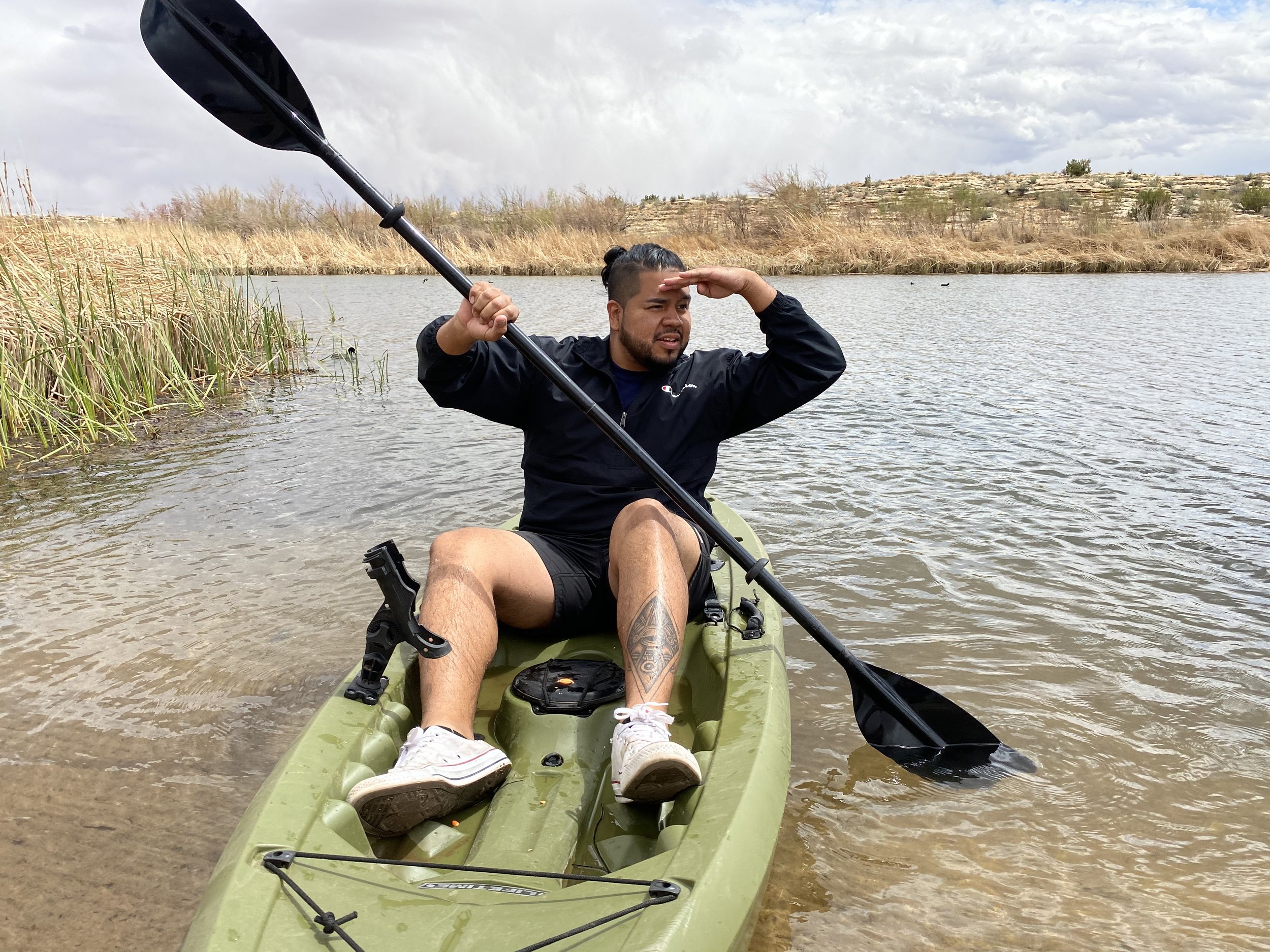
Michael was raised in Arizona, where he became very fond of the landscapes provided in such a dry state. However, when traveling and living in Calgary, Alberta, he found a love for pine, creeks, and moss that grows on north facing rocks. He's also found a love and importance in conservation of all species through hiking, backpacking, and spending plenty of time around animals. His coursework for a bachelors degree in Conservation Biology has allowed him to piece various experiences together and to give him a deeper perspective on why we must protect our environment. Exploring his roots as an indigenous person has guided him the embodiment and the appreciation for the land and what it provides to us as a species.

Reflections from a Recliner

Kieran Wilder

Wilderness Ranger Fellow 

Selway Bitterroot Wilderness - Nez Perce Clearwater NF

Hitches 1-3  6/6-7/11

Appreciation is a word that's been on my mind a lot recently. During my crew's last off hitch, I severely rolled my ankle, fracturing a bone, tearing ligaments, and putting me on the couch for the rest of the season. My goals for the season were to learn the skills it takes to be a wilderness ranger, meet like-minded people, and give back to the wilderness area that I had spent much of my childhood surrounded by. While my season was cut short, I feel like I was able to accomplish much of what I had hoped. Reflecting now as I sit on this cushioned recliner with AC blasting and food at the press of a microwave button, I feel great appreciation.

Connor Adams leading the ridge hike to Fish Lake on Trail #206 (Hitch 3), Photo: Kieran Wilder.

Nez Perce Clearwater Wilderness Ranger Fellows enjoying the view overlooking Eagle Mountain Lake (Hitch 3) Photo: Connor Adams.

Nez Perce Clearwater crew kicking back at Horse Camp cabin after a long day (Hitch 1) Photo: Karlissa Skinner.

I feel appreciation for the place I was able to work. The Selway-Bitterroot Wilderness was where I first backpacked and where my love for wild places was sparked. Being able to give back to this place through the work we do on our hitches is a very rewarding feeling. I think back to my crew’s first hitch at horse camp where we learned how to build a sawbuck to be used to crosscut logs that could be split for firewood. Our crew also monitored campsites around Stanley Hot Springs where we were able to ‘test’ the water in one of the wildernesses best hot springs. 

I feel appreciation for the work that we do. It's easy to feel overwhelmed by the challenge of working in these wilderness areas, and often I found myself forgetting why I was out there. I think back to my crew’s second hitch where we cut close to 700 trees along the Warm Springs and Wind Lakes trails, and forded across Warm Springs Creek (falsely named) each morning just as the sun was rising. In the moment it was sometimes difficult to recognize the value of the work, as your body told you to stop. Now, there is little else I would rather be doing than pulling a saw in a burned area with flies biting or limbing a tree as the rain soaks my boots.

Nez Perce-Clearwater NF Lead Wilderness Steward Connor Adams teaching map and compass skills on the Sponge Mountain saddle (Hitch 3)

Lastly, I feel appreciation for the people I was lucky enough to work alongside. A crosscut saw works best with two people in rhythm and supporting each other's strokes. Much in the same way, a crew’s support for one another allows us to achieve so much more than we could individually. I think of our crew’s third hitch up Eagle Mountain trail to Fish Lake, where long days of hiking were made easier by laughing together and thoughts of cooking dinner that evening. Sharing these special places with my crew was my favorite part of this season.


Enjoying the Sunrise at Fish Lake Cabin before a day of campsite monitoring (Hitch 3) Photo: Olivia Hinds. 

While I would have preferred to avoid this injury and finish out my season, it has given me an opportunity to recognize my appreciation for the places we work and the work that we do. I am more motivated than ever to get back out into the woods and continue to experience the beauty of the Selway Bitterroot Wilderness.

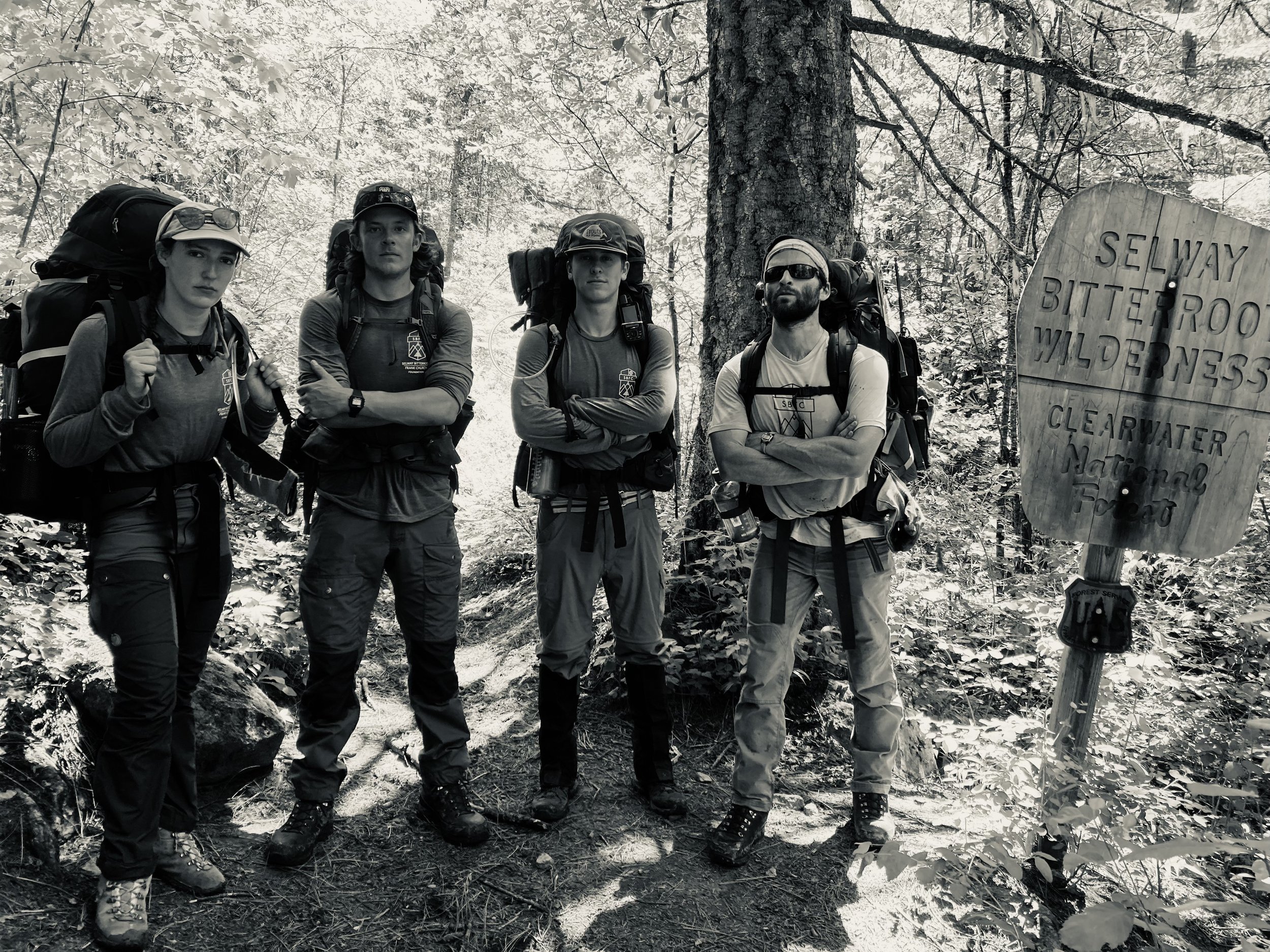
Nez Perce Clearwater Wilderness Ranger Fellows crew circa 1930 (L to R: Olivia Hinds, Kieran Wilder, Ryan Murphy, Connor Adams)(Hitch 1) Photo: Karlissa Skinner.


KIERAN WILDER

Nez Perce-Clearwater National Forest | Selway-Bitterroot Wilderness

Montana State University

Major: Environmental Science & Sustainability Studies

Kieran grew up in Moscow, Idaho and spent much of his childhood backpacking in the Selway-Bitterroot Wilderness where he developed his love for the outdoors. Kieran studied Environmental Science and Sustainability Studies at Montana State University where he furthered his passion for environmental protection and gained knowledge in wilderness policy and management. Kieran’s enthusiasm for wilderness comes from his recognition of the positive impact that wilderness areas have on people and his desire to protect them for future generations. Kieran is very excited to work with SBFC as a Wilderness Ranger Fellow and gain knowledge and skills in wilderness trail work and stewardship.

Past, Present, and Future

Reyna Rodriguez 

Wilderness Ranger Fellow 

Southern Nez Perce Trail | Bitterroot National Forest

July 10 - July 13

SBFC staff and the smokejumpers taking in the views on the Nez Perce Trail

The Southern Nez Perce Trail is said to have seen signs of walking life for over three thousand years. Thousands of people have walked this trail for many different reasons. Today was July 12, 2023 and we are walking this same trail to clear it for future use. We are the future of the forest. I realized this when we got the opportunity to work with retired smokejumpers. They are the past and have many stories of growing up in these mountains. Being able to spend time working with them put into perspective just how much I still had to learn and how much time I had to really live. 

Before the hitch I was worried that I wouldn’t be able to keep up. These amazing men were twice my age, twice my size, and could cut twice as many trees as I could in one day– this seemed like big shoes to fill! They were nice and patient, and taught Hannah, Ian and me all the quick ways they cut trees. They were quick to teach us that the creek is the best way to store your drinks and that they tasted better that way (which I could totally agree with). Many of the smokejumpers were ecstatic and spoke often of the excitement they had to see two young women going into the field. 

Reyna (the author) and Ian enjoying their steak dinner!

Smokejumpers are definitely the only people I know who can saw trees all day and still hang out around a campfire with some whiskey and cigars and tell stories for hours. On the last night of the hitch we were spoiled and had a steak dinner! It was a great change from our usually sad dehydrated meals. Jim (one of the Smokejumpers with an amazing mustache) made a bet that no one could eat another steak. Feeling bold, I took him up on the challenge and crushed another steak. These men were twice my age, twice my size, and could cut twice as many trees as I could in one day… but I could eat twice as many steaks as they could! Feeling full and content in my tent that night, I realized that supporting the future of the forest and trails is the biggest shoe I could try to fill.

The smokejumper camp on the Nez Perce Trail.

The volunteers with the SBFC crew.


REYNA RODRIGUEZ

Bitterroot National Forest | Selway-Bitterroot Wilderness

Western New Mexico University

Major: Forestry & Wildlife

Reyna is a communicative, friendly individual who enjoys camping, fishing, and hiking. Reyna is currently studying at Western New Mexico University and is majoring in Forestry and Wildlife. Reyna found her love for the outdoors at a very young age and has followed that passion ever since.

Expect Nothing, Pull Saw, Slay, Repeat

Julian Brastow

Wilderness Ranger Fellow

Lookout Mountain Ridge Trail | Payette National Forest

Hitch #3 ~ 7/5/23 - 7/12/23

One thing I’ve learned after three hitches of immersing myself in the Lower 48’s largest contiguous wilderness area, is to hike into each day of work expecting absolutely nothing. With my crewmates Dylan and Ariel, I’ve walked up and over mountains, across rivers, and through both vibrant, green, shaded forests, as well as large swaths of scorchingly hot burn scars. It seems that the type of trail maintenance we do involves never knowing what’s around the next corner of trail, which can manifest physically as an easy stroll through a beautiful subalpine forest, admiring the views and moving a log off the trail every ten minutes or so, or a soul-crushing cluster you-know-what of 50 burnt trees fallen across a 100-foot stretch of the trail that is nothing but demoralizing and makes for painstakingly slow progress. During this past hitch on the Lookout Mountain Ridge Trail, we encountered these two extremes, as well as everything in between. It makes for maintaining a steady optimistic attitude an uphill battle, but adds to the adventurousness of our work, and can be extraordinarily rewarding once you learn how to cope with the wildly variable nature of the Frank Church River of No Return Wilderness: go into each day of your hitch with no expectations, and focus on pulling saw through one log at a time.

Before: a particularly rough section of trail

After: the same section of trail after being cleared, with Ariel and I posing with the crosscut saw

The first day of our hitch involved waking up nothing but well-rested and eager to get on the road after America’s favorite holiday, and spending over five hours in the trusty old green suburban, most of which was spent on dirt roads pushing deeper and deeper into the Payette, driving along the beautiful South Fork of the Salmon River and East Fork of the South Fork of the Salmon River (why???). We also learned never to trust Google Maps in Central Idaho. We arrived at Thunder Mountain Trailhead, where we started hiking the next morning, not knowing what to expect, of course. Within the first half mile of the trail we came across cuts that had recently been made, which confused us as to why there had been someone working on the same trail in the same season as us. However, we soon ran into a burn scar chock full of dead trees lying across the trail ready to be cut. Much of the next few days were spent alternating between burnt sections of forest with lots of work, and sections of shaded forest with living trees that did not require much work, as well as bumping our base camp from the trailhead to an enchanted campsite along refreshingly cold and delicious Telephone Creek.

Myself trying to avoid the mosquitoes

On day 5 we made it to Lookout Mountain, which provided sweeping vistas of the rugged Frank stretching to the horizon in every direction, and where we had an impromptu LinkedIn profile photo shoot. The next day we pushed our work farther, and soon encountered the soul-crusher I spoke of previously. This is where my seemingly never-ending optimism reached a breaking point. Clearing a trail that is in this bad of shape can be best described as solving a complex puzzle, starting from the top of the pile of logs and moving to the bottom, deciding which size saw (or brute force) is best suited for each log. We lightened the mood by yelling out names of the various tools we had at our disposal: “Zubát! K-Booooooooy! Visger!!! Liiiiiiiift!”.

Before: the soul-crusher!

After: almost a day's worth of work!

It was a tough, beautiful, and rewarding hitch, and on the last day we hiked our sweaty, dirty, fatigued, and emotional selves back to the trailhead, where on the way we unexpectedly ran into a literal angel. His name was Clay, and within the past year he had become an ICT through hiker, trail angel, and independent guerilla trail maintainer. It turns out he was the one that had cleared that first bit of trail before we arrived. He was so ecstatic that we had done all his work for him, that we were invited back to his campsite and were force-fed ice cold Ahas, Oreos, Fig Newtons, chips and salsa, and the now infamous cracker/pepperoni/cheez whiz combo. I really couldn’t have come up with a better combination of post-hitch snacks. Thank you Clay! I’m looking forward to continuing to develop as a team with Ariel and Dylan on our next two hitches, where I will go into each day expecting nothing, but at the same time knowing I will continue to grow as a wilderness steward, whilst working and frolicking in one of our nation’s most valuable resources.

Work on this hitch was funded by private donors and Idaho Parks and Recreation.


JULIAN BRASTOW

Payette National Forest | Frank Church-RONR Wilderness

Lewis & Clark College

Major: Environmental Studies

Julian grew up in the San Francisco Bay area. While living there, he spent a lot of time with his family going camping and exploring the outdoors and hasn't stopped since. Julian recently graduated from Lewis & Clark College in Portland, Oregon, with a degree in Environmental Studies. He was a trip leader for the College Outdoors program, leading groups of students on outdoor trips in the Pacific Northwest. Julian maintains a strong respect for public lands and wilderness areas and is stoked to spend a summer with SBFC exploring and learning about how to be a great steward to these beautiful places.