

Moose Creek Bears Witness
Sarah Bates
Moose Creek Volunteer Host
June 24 – July 6, 2025
Perhaps you’ve heard of “witness trees”—centuries-old trees living near sites of historically significant events and documented in a Library of Congress archive. People visiting these sites often feel moved to touch the ancient trees and marvel at their persistence.
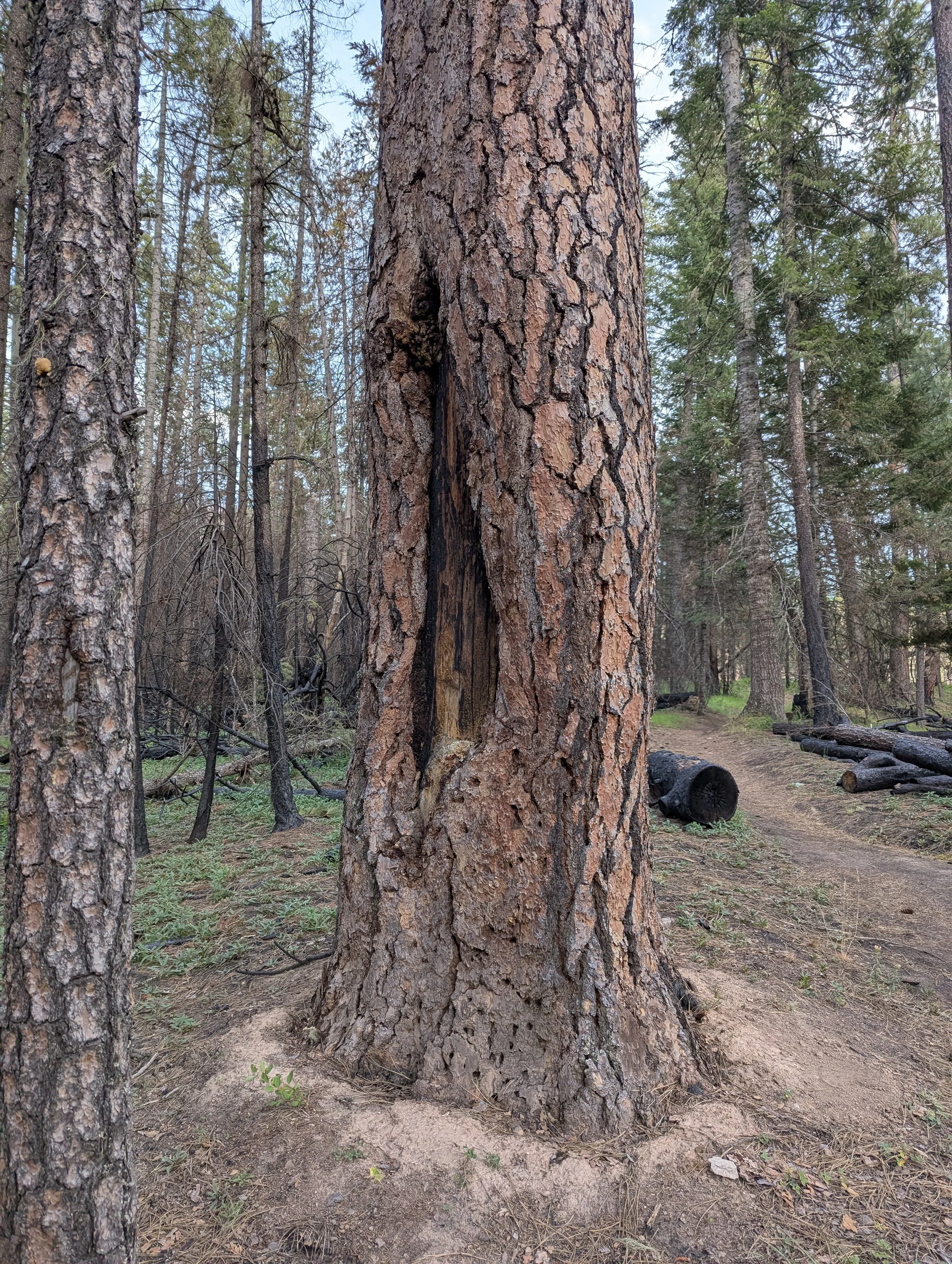
Scarred ponderosa pine near the confluence of Moose Creek and the Selway River, taken by Sarah Bates, Moose Creek Ranger Station Volunteer Host, June 2025.
I’m drawn to witness trees in the wild, undocumented in official registers. These gnarled giants with fire scars, lightning-struck crowns, and ancient peeled bark remind us that we’re all visitors in the long arc of time that plays out on a dynamic landscape.
Over the past two years, I’ve considered how human-built structures might serve this same purpose. As a volunteer host at the 100-year-old Moose Creek Ranger Station in the middle of the Selway-Bitterroot Wilderness, I step briefly into a remarkable corner of living history, where a rich wilderness story continues to evolve.
The log structures comprising the historic Moose Creek Ranger Station supported the Forest Service’s vigorous fire suppression policies that emerged after the 1910 Big Burn, as well as more recent priorities for wilderness protection. Recognizing its significance, the U.S. Department of the Interior added the site to the National Register of Historic Places in 1990.
Moose Creek was a learning lab for the early Forest Service fire program. Rangers, lookouts, and smokechasers sought to snuff out fires before they grew to conflagrations. With a new grass runway in 1931, the agency experimented with aircraft to support fire suppression efforts, and the first-ever team of smokejumpers launched from Moose Creek in 1940.

Selway Bitterroot Frank Church Foundation Trail Crew Leader, Enzo, heading off hitch at Moose Creek Ranger Station, taken by Sarah Bates, Moose Creek Ranger Station Volunteer Host, July 2025.
The Forest Service recognized the Moose Creek Ranger District’s superb wilderness characteristics by managing it as a primitive area starting in 1936, and Congress included the Selway Bitterroot Wilderness in the original 9.1-million-acre National Wilderness System in 1964. Wilderness designation prohibits motorized and mechanized equipment and transport, so this designation sparked a revival of near-lost skills like clearing trails with crosscut saws.
Thanks in part to its historic role in Forest Service aviation, the 1964 wilderness legislation allowed aircraft to continue to land at Moose Creek. Today, private airplanes are frequent visitors to Moose Creek, often flown by people with long histories here. Several private pilots serve as long-time SBFC volunteer hosts; many volunteer for work parties to maintain the facilities.
A volunteer host’s responsibilities include tracking airfield landings, monitoring informal campsites, facility maintenance, and encouraging visitors to see themselves as wilderness stewards. During the Selway River floating season, boaters walk up from the river to tour the historic ranger station, hike to the nearby Shissler Peak lookout, pet the stock in the corral, and visit with trail crew members resting between hitches.
This past June, I met Sven Magnuson and Debbie McElroy, who backpacked into Moose Creek over a rough, steep trail from Elk Mountain. Arriving at the Ranger’s house (now the volunteer host’s residence), Sven remarked that this was his first visit since he was a baby, when his dad, Bill Magnuson, served as the Moose Creek District Ranger in 1960-61. Anyone who has seen the excellent PBS documentary “Higgins Ridge” is familiar with the remarkable presence of mind and leadership the elder Magnuson displayed when two crews of smokejumpers were caught in the middle of a raging fire in 1961. Our moving conversation reminded me that every historic event is someone’s family story.

Sven Magnuson (son of former Moose Creek District Ranger William Magnuson) and Debbie McElroy visiting Moose Creek Ranger Station on June 28, 2025, taken by Sarah Bates, Moose Creek Ranger Station Volunteer Host.
Throughout my stay, I marvel at the ingenuity and self-sufficiency of those who built the ranger station structures by hand from local materials and maintained them with whatever they had on hand. It’s a rare experience to live and work off-line and off-grid, and it feels good to know that this small effort helps the Forest Service keep this remarkable historic site protected and open to the public.
As dusk arrives and I sit quietly enjoying the changing light, I think of all who have experienced this place and contributed to its history. And I can’t help but see Moose Creek Ranger Station itself as a silent witness to a century of evolving lessons in how to co-exist with a wilderness landscape.
More Info:
SBFC’s role in stewarding Moose Creek: https://ppolinks.com/forestservicemuseum/2021_5_60.pdf
Sarah Bates is a volunteer lookout host at the Moose Creek Ranger Station in the Selway-Bitterroot Wilderness.