
Levi Armichardy
College of Idaho Student / Trail Crew Leader
Another one? Oh boy! Most people might feel something like frustration or anger when they see the trail disappear into a tangle of brush, branches, bark, and wood. However, there are a few crazy people who get excited, who for some reason find some enjoyment in muscle fatigue and a faceful of brush. We’re called “trail crews.” We tend to work in the background, but if you’ve ever hiked on a trail without having to climb over logs or fight through brush, you’ve seen our work. Down the trail behind me, two of my crewmates pulled a crosscut saw through a massive log, while 4 others worked on cutting back the brush that engulfed the trail. I personally was armed with loppers, a Katanaboy handsaw with a formidable 3-foot blade, and a pulaski (a combination of an axe and a hoe). I set down my pack and went to work.
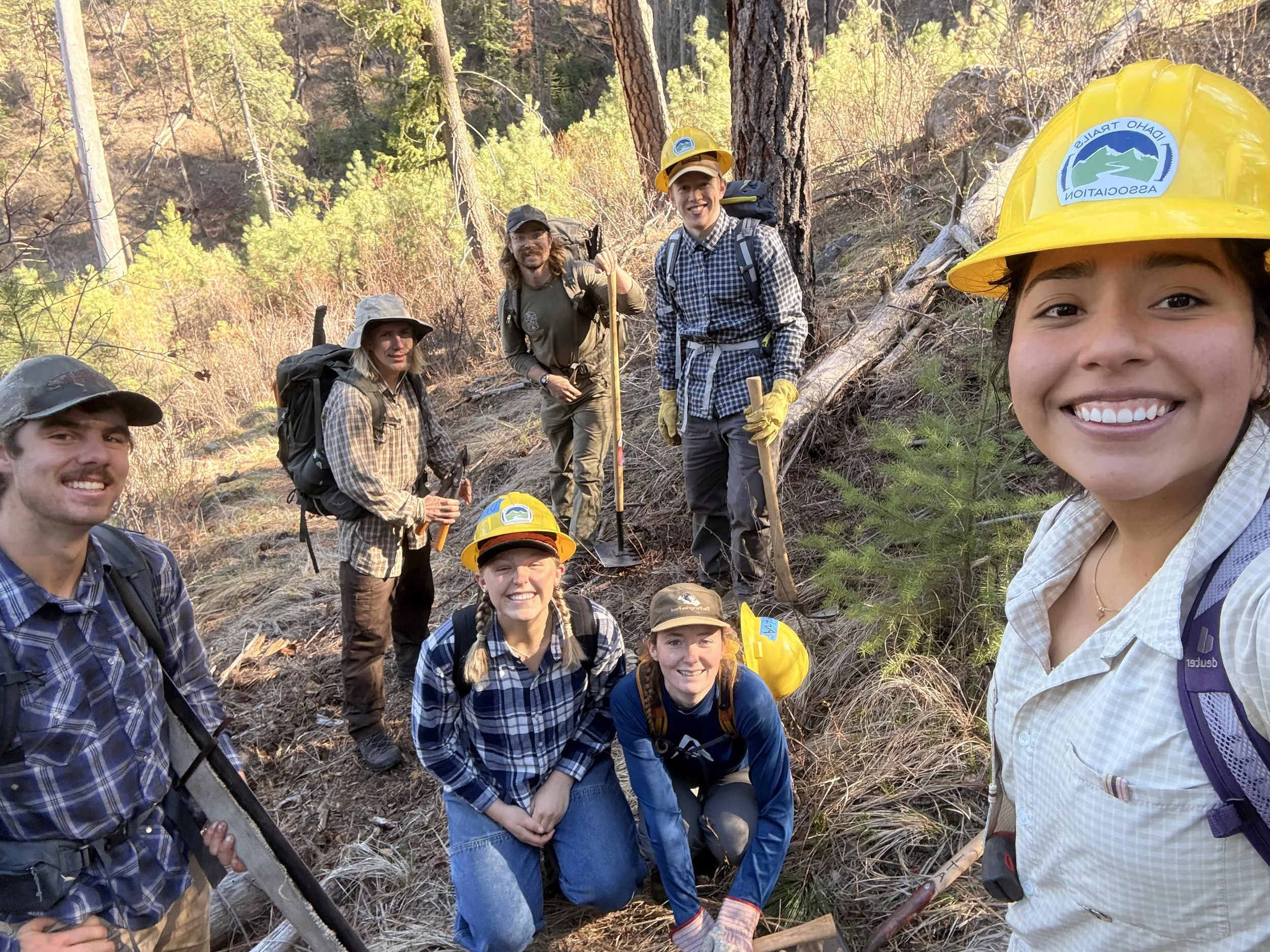
On March 21, I woke up in a dorm room at the College of Idaho in Caldwell. I went to bed that night in a tent on the banks of the Snake River in Hells Canyon. I was the leader of a 7-person trail crew, a joint effort by the Idaho Trails Association, the Selway Bitterroot Frank Church Foundation, and College of Idaho Outdoor Program. Our objective: clearing the Little Granite Creek Trail, which climbs 6000’ in 7 miles from the mouth of Granite Creek to Hibbs Cow Camp in the Seven Devils. Since I first scouted the trail in 2022, several ITA crews had worked from the top and bottom to re-open it. Over the course of a week, we’d build on the efforts of those previous crews, pushing upward.
It took me an hour of clearing brush and branches just to reveal the 30-inch trunk of the ponderosa. Full-sized saplings grew in the trail beneath it, indicators of just how long this log had laid here. I felt a pang of regret as I cut them down, leaving their white stumps bleeding sap. What right do I have to determine who lives or dies? I thought as I tossed the saplings out of the trail corridor. Why should these trees die just so I can walk easily down a trail? It’s a question of ethics that’s occurred to me before while pulling a saw through a rotten log and watching ants crawl out or wielding a pair of loppers in a thicket of brush. How is disrupting or ending the lives of other beings an act of stewardship? The answer I’ve settled on for now (though I’m still pondering it) is this: if killing saplings to clear a trail creates opportunities for more people to access the area, then perhaps those people will feel some sort of connection to the land, and through that connection they will be more inspired to care for it. In sacrificing a few, I’m working toward the protection of the entire ecosystem. At least, that’s what I tell myself as I continue lopping brush.
Camping on the river afforded us the luxuries of a wall tent, fresh food, and easy fishing access. It did not make for an easy commute to work. We started up the trail each day around 8:30 AM, just as the sun brushed the top of the canyon wall with orange. In a mile we came to our first creek crossing at the old Hibbs Ranch. Another mile, another crossing. On our first day up, knowing we’d be doing this a lot, we’d taken some time to build a temporary bridge of alder logs. Another steep mile, another crossing. This is where we’d officially begun work on the first day, improving the crossing by digging tread, building a rock wall, and clearing brush. No bridge for this one, just a series of slippery moss-covered rocks. We rest for a bit before continuing up. Another mile, another crossing. On our first day of work on this section, we’d cleared most of the plentiful logs and brush that had obscured the trail here on the north side of the creek. Our second day brought us to the fourth creek crossing (more slippery rocks) and through a landslide on the other side. In these two days, everybody learned the basics of crosscut-saw-pulling, pulaski-swinging, and brush-lopping. We’d built rock walls, re-opened the trail through the landslide, and cut some pretty tricky trees on steep hillsides. Turns out, all that was just a warmup for the third day.
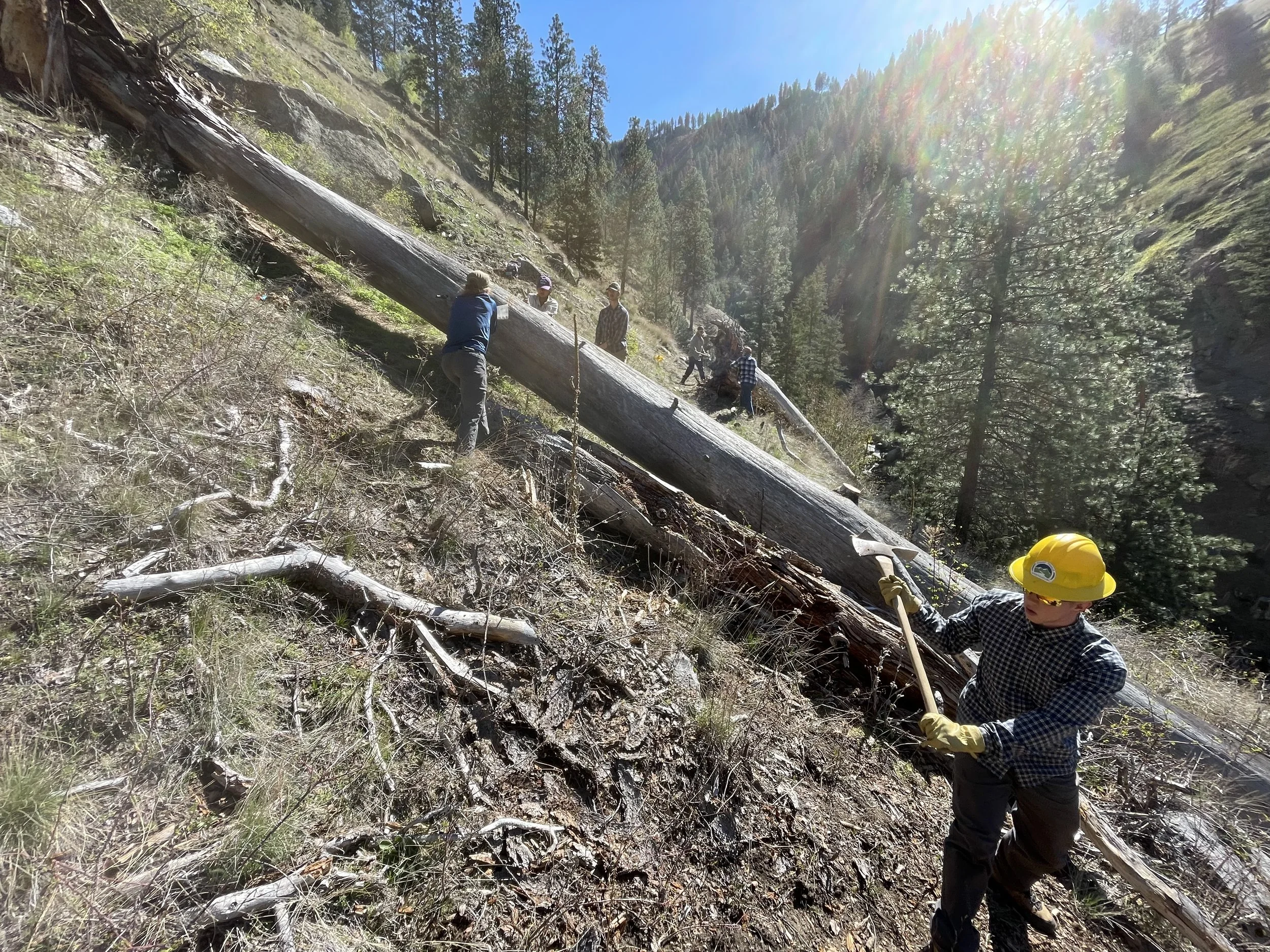
I finished prepping the log just as two of my crewmates arrived with the crosscut after finishing the previous “big one,” the second one of the day. We discuss the cut plan - two cuts, angled to allow the log to drop and roll out of the trail. I take a position on the downhill side, and my partner hands me the saw across the log. We line the saw up with our planned cut. A few short strokes start the kerf (the gap formed by the saw), then we move to full strokes as the saw stabilizes. We move our whole bodies in a back-and-forth rocking motion with the saw, each of us in turn pulling the length through then guiding it back as the other pulls. It’s hard to describe the sound a well-sharpened crosscut saw makes as it cuts through a log. A sound of abrasive metal on wood, punctuated by brief pauses as the saw changes directions, with a faint ringing sound throughout, a song to those who pull. I let myself be absorbed by the song and the movement of the saw. My focus narrows to the teeth, the sawdust, and ever-deepening kerf.
Trailwork is repetitive. Pull, guide, repeat. Raise, swing, repeat. Lop, throw, repeat. Back and forth, up and down. It’s not all completely mindless physical work - each log is a puzzle of how to move it with the least amount of effort and danger - but there are undeniably long periods of repetitive motion with no music or TV or social media or anything else to distract you from your own thoughts and movements. I suppose some people might find it boring. Some might be driven crazy by the silence inside their head. Me? I love it. All of my worries and troubles fade away. The homework waiting for me in the frontcountry doesn’t matter. How I look doesn’t matter. What somebody said about somebody else doesn’t matter. Even larger things like the state of the global economy seem distant. Worries about things I can’t change disappear, replaced by a focus on the things I can change. Individual actions are re-empowered. I can’t end an international war, but I can master the next pull of the saw, the next swing of the pulaski. There’s a certain purity in such striving. I think that perhaps some of the value of trailwork lies in the forgetting of things that don’t matter and the remembering of some of the things that do - hard work, a good crew, and the satisfaction of a job well done.
Kneeling on the downhill side, I can’t see my partner pulling the saw on the other side. We’ve finished the cut on one side of the log and are now three-quarters of the way through the other. I watch the kerf for signs of widening, ears straining for the crack that indicates the beginning of the end. I don’t want to be here when the log breaks free - it’d steamroll me in an instant. So I watch and listen and communicate with my partner. We stop to pound the wedges (four of them!) deeper into the kerf. Back to sawing. “6 inches left on my side.” “Same here.” Finally, a crack. A few more strokes. More cracks. Time for me to leave. I take the handle off my end of the saw and retreat down the trail a few feet, out of the fall line. My partner finishes the log “single-bucking,” pushing and pulling the big saw from the uphill side. When, at last, he breaks through, the log rolls nicely down and out of the trail. By that time, it was late afternoon, and the others had returned from brushing farther up the trail. Having cleared 3 big trees and several hundred feet of thick brush, we called it a day and started the trek back to camp.
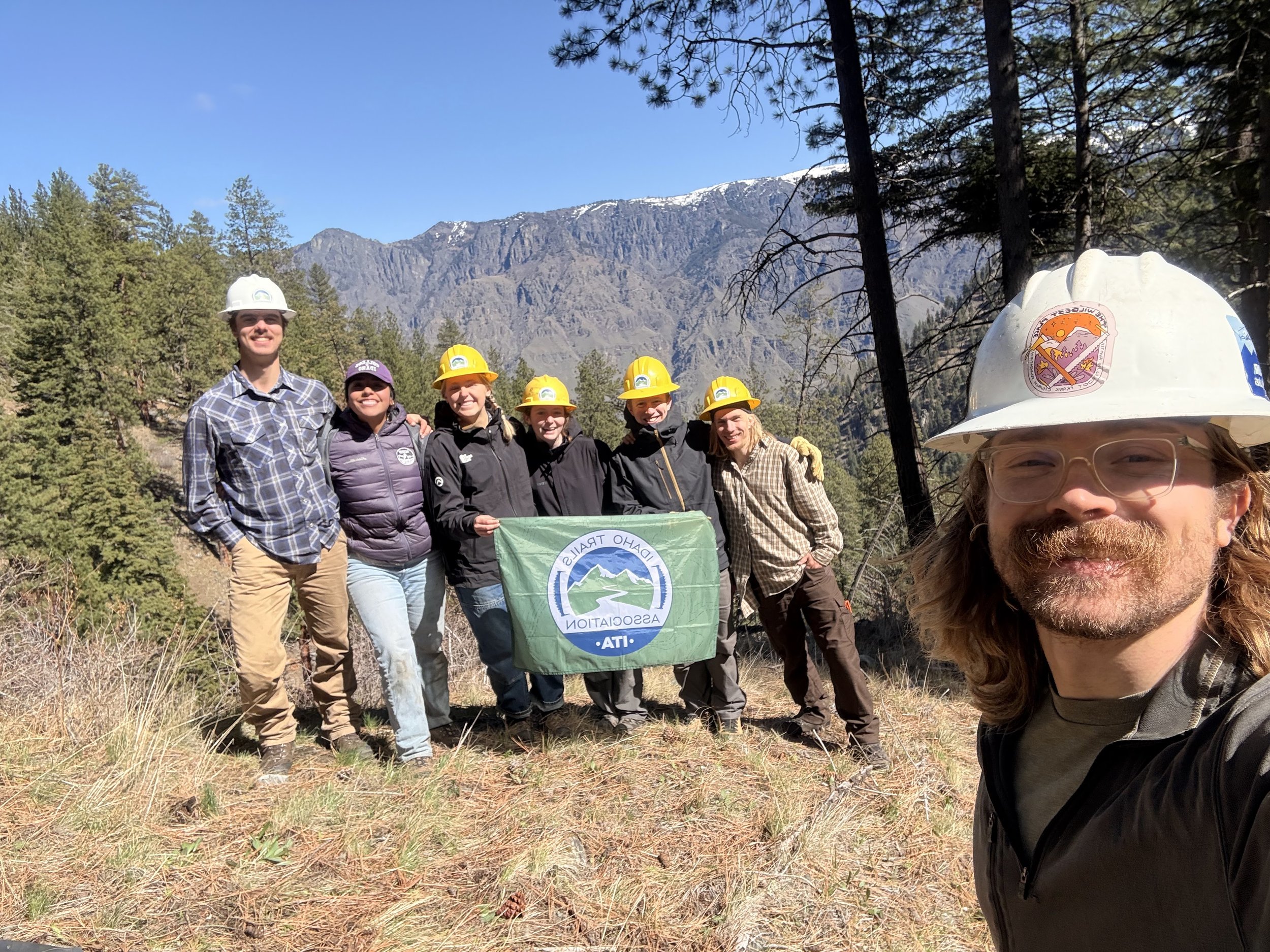
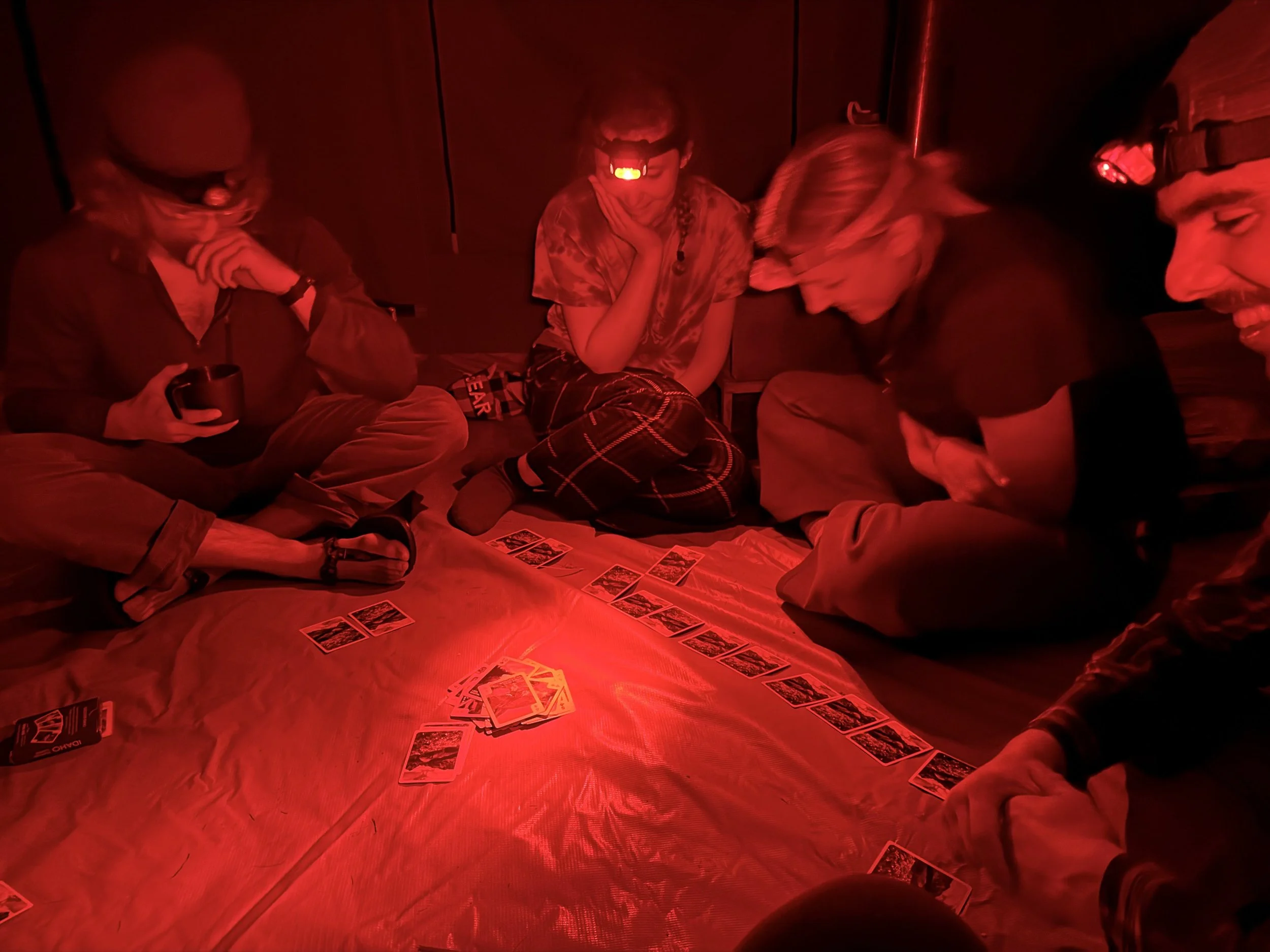
Two days later, I watched the flat that had been our home for a week disappear around the bend as the roaring jet boat motors pushed us upriver. The final stats for our trips were as follows: 51 trees cut, 960 feet of brushing, 660 feet of treadwork, 3 drains dug, and 1.5 total miles of trail cleared. Across four work days, we hiked 24 miles with over 10,000 total feet of elevation gain and loss. Statistics don’t get everything though. They don’t capture the satisfaction of hiking back down the trail each day and seeing the work we’d done, nor the excitement of the 34 times we crossed Little Granite Creek on slippery rocks and logs. You can’t reduce the grandeur of Hells Canyon in the spring to mere numbers: green hillsides dotted with blooming syringas, snow on the upper elevations, and blue sky above. And stats completely miss the little moments of community: stretch circles in the morning, fishing after work, sharing meals in the wall tent, playing cards in the red glow of our headlamps. There just aren’t any numbers to capture the fulfillment of doing good hard work with fun people in beautiful places.
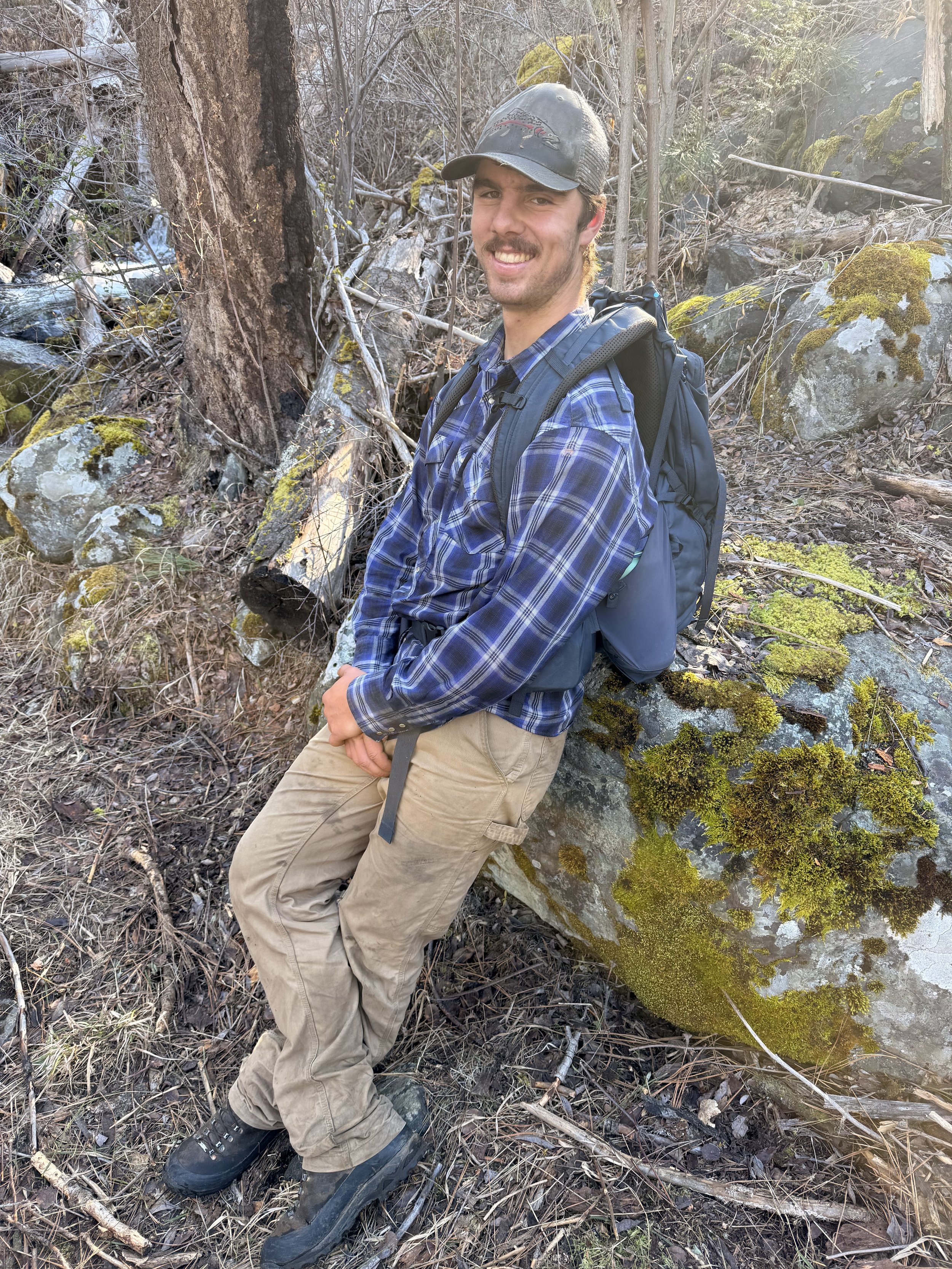
Levi Armichardy is a horseman, backpacker, hunter, and trails person who grew up in the Idaho backcountry. He is currently an Environmental Studies major and Outdoor Program Trip Instructor at the College of Idaho. In addition to being outside, Levi enjoys reading, writing, and playing guitar.